
Start with the model
The 6A Coaching Framework
An introduction to the whole coaching journey: purpose, agreements, understanding, choices, workplace practice and continuing review.
View PDFHR DELIVERY / COACHING
A focused conversation can change how you approach your work. Our coaching helps leaders, teams and practitioners make sense of challenges, explore possibilities and turn insight into purposeful action.
THINK CLEARLY. MOVE FORWARD.
Coaching is a purposeful developmental partnership. Through careful listening, questions, reflection and constructive challenge, your coach helps you understand your situation, consider choices and decide how to act. You bring the goals and experience; together, we create the space to work on them.
It can be useful when you are stepping into a new role, facing a difficult decision, responding to feedback or putting new learning into practice. The conversation is shaped around your context and the change you want to make.
Separate the important issue from the noise and identify a useful next step.
Understand your habits, strengths and impact through reflection and feedback.
Explore options, test assumptions and prepare for decisions or conversations.
Try a different approach, gather feedback and build on what you learn.
ONLINE EXECUTIVE COACHING
Explore another way to support your development. Our online AI coaching experience is being developed to help you reflect on leadership challenges, explore practical development ideas and make sense of assessment results. You can also use it for standalone executive coaching without an assessment.
The experience is currently a preview. Live AI coaching conversations are coming soon.
Explore Online AI Executive Coaching
KNOWLEDGE. TOOLS. PURPOSEFUL PRACTICE.
Understand the 6A framework, choose a stage guide, find a better question and select an activity for the work in front of you. These resources support coaches, coachees and programme owners in connecting a conversation with practical development.
Read the full documents on screen. This collection is view-only.
Start with the model
An introduction to the whole coaching journey: purpose, agreements, understanding, choices, workplace practice and continuing review.
View PDF
Put the framework to work
The complete 6A practitioner toolkit, with 160 tools and activities, coach guidance, working forms and clearly identified worked examples.
View PDF
Deepen your understanding
Build a deeper understanding of developmental relationships and the design of coaching and mentoring programmes that support learning at work.
View PDFTHE HR DELIVERY 6A WORKPLACE COACHING SYSTEM
Select an A to explore its purpose, practical outcome, detailed guide and 100-question pack. The framework spans the organisation, the programme and the individual coaching relationship.
Return to an earlier A when purpose, evidence or circumstances change. Assurance continues throughout.
STAGE 1 / Align
Connect coaching with a worthwhile purpose, establish whether it is the right response and make the conditions for useful development visible.
Charter and a clear account of expected value.
26 tools and activities 100 coaching questions
STAGE 2 / Agree
Create a trustworthy relationship through clear roles, rights, confidentiality, sponsor expectations and practical working arrangements.
An agreed relationship, confidentiality and working arrangements.
19 tools and activities 100 coaching questions
STAGE 3 / Assess
Understand the person in their work, use assessment and feedback proportionately, and agree a useful goal and starting point.
A useful goal, a starting point and an understanding of the situation.
28 tools and activities 100 coaching questions
STAGE 4 / Activate
Use questions, visual exploration, perspective-taking and rehearsal to develop insight, open options and support choices owned by the coachee.
Insight, practical options and a commitment owned by the coachee.
38 tools and activities 100 coaching questions
STAGE 5 / Apply
Turn a chosen action into a workplace experiment, identify support and feedback, and review what the experience teaches.
Workplace experiments, feedback and a plan for learning transfer.
24 tools and activities 100 coaching questions
STAGE 6 / Assure
Review quality, evidence and contribution. Decide what to continue, adapt or stop, and close or renew the relationship responsibly.
A responsible decision about quality, value and the next step.
25 tools and activities 100 coaching questions
Need the whole picture? Read the framework introduction or the complete practitioner toolkit.
THE QUESTION LIBRARY
600 questions, with 100 for each stage of the 6A model. The individual booklets explain when and how to use a question and the development it can support. Choose thoughtfully and follow the person’s response.
600questions across the full journey
Explore purpose, organisational context and whether coaching is an appropriate starting point.
Clarify expectations, roles, boundaries and the agreements that allow an honest conversation.
Understand evidence, behaviour, feedback and the circumstances behind a development goal.
Open alternative perspectives, explore choices and develop a commitment owned by the coachee.
Plan experiments, explore support and feedback, and bring learning into everyday work.
Examine contribution, quality and independence, and decide what should continue or conclude.
CHOOSE BY PURPOSE
Six activity guides help you find an exercise around a goal or situation. Read the coach guidance, agree the activity, explore the participant’s own evidence and finish with a useful conclusion and a realistic workplace experiment.
Explore what matters, clarify values and direction, and turn a broad ambition into a goal that can guide the coaching work.
Explore this activity guide
Reflect on career choices, strengths and leadership experience. Examine confidence through evidence and consider a realistic next step.
Explore this activity guide
Build confidence through workable action, review habits and attention, and plan more sustainable use of time and energy.
Explore this activity guide
Review what changed, facilitate useful participation and create space for individual or group reflection and learning.
Explore this activity guide
Structure the coaching relationship and support owner-led decisions, with attention to practical responsibilities and follow-through.
Explore this activity guide
Connect programme planning, question banks, forms and supporting reference material into a coherent development approach.
Explore this activity guide152 ACTIVITIES AND PRACTICE RESOURCES
Use the directory to locate a resource by purpose, then use its page reference in the complete master toolkit. The master includes coach guides, participant pages, fictional examples and debriefs.
THE PRACTICE AROUND THE CONVERSATION
Good documentation supports a trustworthy coaching relationship. Explore contracting, preparation, goals, session records, progress reviews and closure. Choose the record that serves the agreed purpose and read its guidance before use.
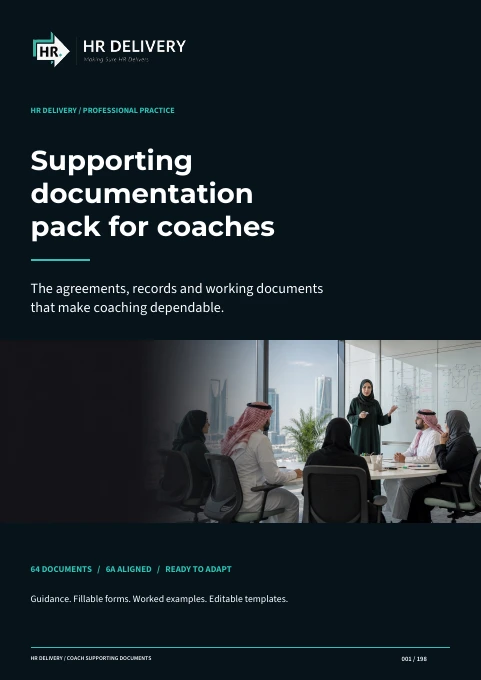
Guidance and examples
Guidance for 64 operational documents covering agreements, preparation, progress, review and professional practice, with working examples.
View PDF
Working records
The companion collection of 64 blank records. Read each alongside its matching guide before using it in an authorised coaching engagement.
View PDFRead these companions alongside the relevant toolkit or activity guide. The PDF workbook reference includes every supplied spreadsheet tab as reading material; its calculations are not interactive.
72 activities and reflection pages for work with a coach, connecting personal evidence, choices and realistic workplace practice.
Participant working pages for the additional coaching exercises, to read alongside the relevant coach guide and debrief.
Selected visual activities from the complete toolkit, including context wheels, leadership lifelines, time-use comparisons and decision matrices.
A PDF reading edition of all 183 companion worksheets, preserving their labels, prompts and reference indices. Spreadsheet calculations and charts are not interactive.
FOUR WAYS TO WORK WITH US
Choose focused support for yourself, a team or a development programme. We shape the goals, evidence and working arrangements around what will be useful to you.

FOR LEADERS
Dedicated thinking time for leaders facing greater responsibility, complex decisions or organisational change. Explore your leadership impact, stakeholder relationships and personal approach to delivery with an independent coach.
Bring a live challenge: a role transition, a difficult relationship, delegation or a strategic decision.
A clearer priority, practical choices and a commitment you can test in your leadership role.
Available as a standalone engagement. An assessment is not a prerequisite.
Discuss executive coaching
FROM INSIGHT TO DEVELOPMENT
Our extensive assessment catalogue offers a useful starting point for development. Coaching helps you interpret results in the context of your role, explore strengths and feedback, and choose priorities that matter in practice.
Explore behavioural and technical competencies, career direction, workstyles, leadership preferences, situational judgement or 360 feedback.
A focused development plan, workplace experiments and a way to review progress beyond the report.
Results support a conversation. We check them against experience and context, rather than treating a score as the whole person.
Explore our assessment catalogue
THE TEAM AS A WHOLE
Help a team understand its shared purpose, relationships and patterns of working. After an agreed assessment and debrief, coaching creates space to discuss the findings, work through live challenges and practise more effective ways of collaborating.
Draw on the Team Workstyles Indicator, Team Contribution Profile and Team Performance WatchPoints, where appropriate.
Shared commitments for decisions, communication, feedback and accountability, reviewed through real team work.
We work with the team collectively. Findings are a starting point for dialogue, not labels or rankings of team members.
Explore team assessments
LEARNING THAT REACHES WORK
Add individual or group coaching around a development programme or workshop. Work on a real application goal, reflect on what happened when you tried it, and adapt the approach to the demands of your workplace.
Support can take place before, between or after facilitated learning, with the pattern agreed around the programme.
Greater continuity between learning and work: a practical goal, supported practice and evidence to review.
Coaching complements instruction and practice. It gives participants time to work on how they will apply what they have learned.
See the six programme connectionsBEYOND THE LEARNING ROOM
Coaching can accompany any of our six development programmes, as well as relevant workshops. The programme builds knowledge and skills; coaching helps participants work with the opportunities and obstacles they encounter when applying them.
Choose an application goal.
Practise and reflect with support.
Review evidence and sustain progress.
Prepare a stakeholder conversation, strengthen your consulting approach and translate business priorities into practical people actions.
Explore this programme 3P9CApply the Productivity, People and Performance model through delegation, feedback, team routines and accountable follow-through.
Explore this programme 3D9CApply Direction, Development and Delivery to a live leadership challenge, drawing on assessment feedback and the nine competencies.
Explore this programme ODReflect on diagnosis, contracting, facilitation and team dynamics while working through a real organisational development assignment.
Explore this programme CCPWork through stakeholder engagement, change communication, project decisions and the challenges of delivering as an internal consultant.
Explore this programme FPQPrepare a facilitated session or improvement experiment, explore resistance and use evidence to decide what to improve next.
Explore this programmeA RELATIONSHIP YOU CAN TRUST
All our coaches are qualified and all have regular supervision. Supervision provides structured space for coaches to reflect on their work, strengthen professional judgement and maintain the quality of their practice.
We discuss your goals, professional context, language preferences and coach fit before agreeing the engagement.
We agree what stays within sessions, any limits to confidentiality and exactly what progress information a sponsor may receive.
We consider the culture, relationships and organisational realities in which you work, including the opportunities and expectations of the Gulf.
We review agreed goals, examples of changed practice and relevant feedback. Value is judged through useful application, not session attendance alone.
Yes. We can agree in-person, remote or blended coaching, with session frequency, duration, language and practical arrangements shaped around the engagement.
We agree an initial scope around your goals and review progress at defined points. A focused transition, a longer development goal and team coaching may need different arrangements; there is no single package that suits every need.
No. Executive coaching can stand alone. When assessment is useful, we agree the purpose, select relevant tools and provide a debrief so the evidence supports your development.
We agree this before coaching begins. Updates may cover agreed goals, participation or progress themes. Personal session content is handled within the confidentiality agreement and its stated limits.
Coaching uses questions, reflection and challenge to help you develop your own responses. Training builds particular knowledge and skills; consulting supplies specialist advice or delivery support. We agree the right approach and make any change of role explicit.
We begin with a clear goal and a picture of useful progress. At review points, we examine workplace actions, relevant feedback and the participant’s or team’s experience, then decide what to continue, change or conclude.
YOUR NEXT CONVERSATION
Tell us about your role, team or development priority. We will help you explore whether coaching is the right starting point and shape support around the work you need to do.