

YOUR PROFESSIONAL RESOURCE COLLECTION
Deepen your knowledge.
Sharpen your delivery.
Start with the country context, reflect on a short insight, then explore longer articles and research. Deepen your understanding through eBooks and put it into practice with our toolkits. Follow the journey at your own pace, with our frameworks connecting the ideas to your work.
ONE FOUNDATION. SIX PATHWAYS.
From knowledge to practice.
EXPLORE THE COLLECTIONS
Find what moves your work forward
Six connected collections. Start wherever you need support.
Experience, shared with you
Long Read Articles
Browse all 61 articles here. Search for a subject, choose a topic, or open any article to start reading.
Showing all 61 articles · Original English editions
No articles found
Try another search or choose All articles.
E-books
Our e-book collection will be added here. In the meantime, explore our published long read articles.
Explore Long Read ArticlesTHE GULF / COUNTRY GUIDES
Understand the region.
Know the differences.
Six countries, connected by geography and shaped by distinct histories, economies and working lives. Start with a country, or explore the complete regional reference.
Country outlines for orientation. Silhouettes are individually scaled, not a comparison of land area.
THE COMPLETE COLLECTION
One regional view.
Six local perspectives.
Before advising an organisation, understand the place in which its people live and work. A skyline, a growth figure or a summary of employment conditions is only a starting point.
The opening 24 pages bring the region into focus. The six country briefs then add the detail: background, people, employers, business conditions and the practical realities of living and working in each country.
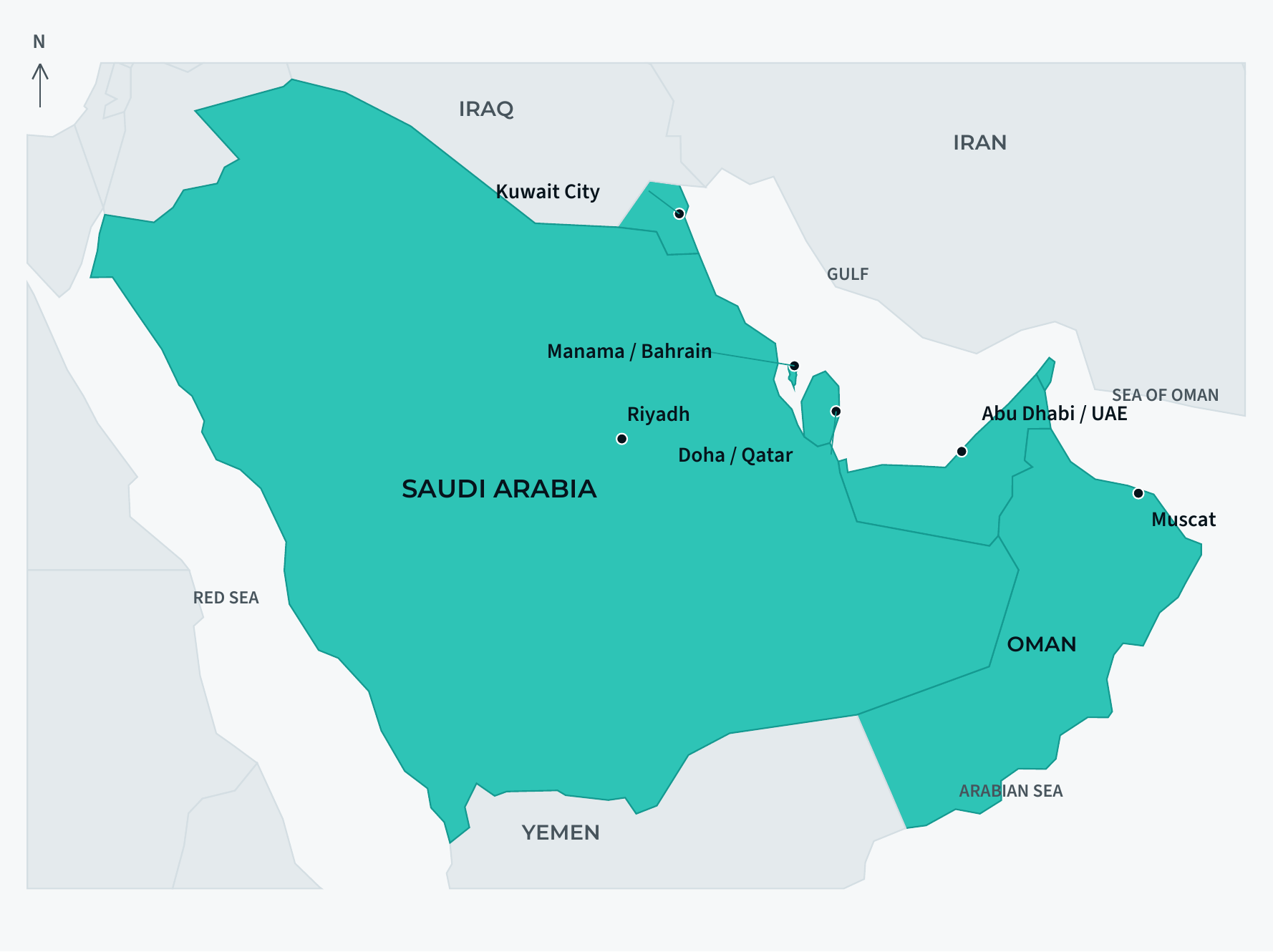
Generalised Natural Earth boundaries; Bahrain main-island coastline from GSHHG. Geographic orientation, not an official boundary map.
A PRACTICAL STARTING POINT
Get to know each country.
Expand a profile for a focused introduction, then open the complete 16-page guide.
01Saudi ArabiaScale, transformation and regional opportunity.
The working geography
Riyadh, Jeddah and the Eastern Province are distinct settings for work. A corporate headquarters, an industrial site and a hospitality operation can have very different talent pools and daily journeys.
People and the economy
The guide connects national history and institutions with energy, industry, investment and newer sectors. It places national capability alongside the practical demands of international recruitment and development.
Prepare your conversation
Identify the region, worksite and project stage before discussing talent or reward. Build the conversation around the actual role, supervision, progression and the household’s relocation needs.
02QatarAn international workforce and a concentrated urban economy.
The working geography
Doha and Lusail provide a different working environment from the industrial settings of Ras Laffan and Mesaieed. A compact country still contains very different workplaces and commuting patterns.
People and the economy
LNG is central to the guide’s economic picture, alongside aviation, finance, education, healthcare and other services. National development and a highly international workforce give workforce planning a particular context.
Prepare your conversation
Clarify the worksite, required skills and employment arrangements. For a move, consider school availability, medical cover and the final part of the journey to work, as well as housing.
03United Arab EmiratesSeven emirates. Connected cities. Distinct settings.
The working geography
Abu Dhabi, Dubai, Sharjah and the northern emirates should not be treated as a single commuting or employment market. Federal identity sits alongside emirate-level institutions and local economic priorities.
People and the economy
Trade, logistics, aviation, energy, finance and services create a varied business landscape. The guide distinguishes the needs of regional offices, industrial operations, visitor businesses and digital services.
Prepare your conversation
Start with the emirate, employer and operating jurisdiction. Compare roles within a relevant sector and location, and test the full relocation proposition rather than salary or rent in isolation.
04OmanMaritime connections and diverse regional economies.
The working geography
Muscat, Sohar, Duqm, Salalah and Musandam represent different places to live and work. The long coastline and separate industrial and port centres make location an essential part of the HR brief.
People and the economy
The guide links maritime history and local communities with energy, ports, industry, tourism and regional trade. National capabilities and opportunities outside the capital are part of the wider development picture.
Prepare your conversation
Establish which operating centre the role supports and how the work is organised. Explore local capability, travel, accommodation and family arrangements before assuming a capital-city employment model.
05BahrainAn island economy built on international connections.
The working geography
Manama, Muharraq, Sitra and the southern industrial areas bring different working patterns. Short distances do not remove the need to check the actual route, work schedule and location.
People and the economy
Finance sits alongside aluminium, refining, logistics, aviation, hospitality and digital business. The guide places modern services and industry within a longer history of pearling and maritime commerce.
Prepare your conversation
Match workforce assumptions to the business activity. Consider the role of national capability and career progression, and distinguish an office-based job from port, manufacturing or shift operations.
06KuwaitMerchant traditions, energy and public-sector influence.
The working geography
The Kuwait City corridor differs from southern energy and industrial locations such as Ahmadi and Al Zour. Workplace, school and shift patterns need to be considered together.
People and the economy
Petroleum, banking, retail, property and services form the guide’s economic setting. Merchant history, institutions and the role of public employment provide context for conversations about careers and national talent.
Prepare your conversation
Define the employer, sector and job family before selecting a comparator. Separate the employer’s career and reward commitments from wider support arrangements, and review the full household proposition for international hires.
READ WITH A PURPOSE
Start with the question in front of you.
Choose a topic to open the Gulf guide at the relevant section. Each country follows a common structure, making it easier to read across the region.
Better context. Better questions.
Before a client conversation
Understand the country, sector and worksite before discussing an organisation. Use the guides to prepare, then test your understanding with people who know the local context.
Before a workforce comparison
Read the date and definition behind every figure. Population, employment and social-insurance records count different things; similar job titles may also conceal different responsibilities.
Before an international move
Consider the whole employment and household proposition: the work, the commute, housing, schooling, healthcare and support on arrival. The practical details can determine whether a move succeeds.
Based on the supplied HR Delivery Gulf and country guides, October 2026 collection. Figures in the PDFs retain their own reference dates. These resources provide country context; they are not a salary survey or a substitute for local legal, tax or immigration advice.