

← Learning & Development Department
S8 / PRACTITIONER SPACE
Succession Planning
Protect critical work. Build credible successors.
Follow the eight decisions of S8: identify critical future work, test role-specific evidence and build funded development and continuity plans.

READ THE METHOD. USE THE RECORDS.
Your practitioner library
Original guides and reusable records, connected to the decisions below.

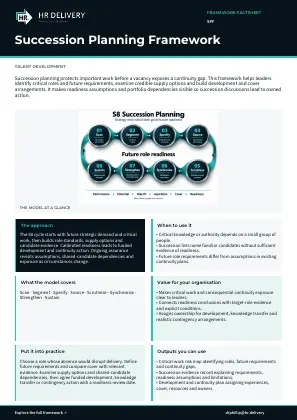
S8 / THE PROCESS AT A GLANCE
8 connected decisions
Choose a step. Read the guidance, gather its inputs and use the matched records before moving on.
Return to earlier decisions when new evidence changes the assumptions. The toolkit’s Discover, Diagnose, Design, Deliver and Review sections organise its records; the S8 decisions control this process.
STEP 01 / 08
Scan
What to do
Identify future outcomes, capabilities and critical work over the next 24–36 months and beyond. Agree scenarios and a shared mandate before discussing candidate names.
Bring these inputs
- Approved strategy, workforce plan, operating model and executive mandate.
- Project pipeline, leadership interviews and credible strategic scenarios.
- Affected work, dependencies, assumptions and monitoring triggers.
Working documents for this step
D7-D05
Strategy-to-succession canvas
Open working record · page 8 ↗Read the matching procedure · page 18 ↗Use the working records for this decision. Sponsor judgement and approval stay with the organisation.
STEP 02 / 08
Segment
What to do
Identify roles with disproportionate strategic or continuity impact, including technical and operational roles. Assess structural criticality before considering the incumbent; keep vacancy exposure separate.
Bring these inputs
- Approved role scope, role profiles, service/risk evidence and informed rater notes.
- Current positions, tested cover, credible successor depth and knowledge transfer.
- Defined horizon and approved criticality/exposure methods, including any override.
Working documents for this step
D7-D11
Vacancy exposure assessment
Open working record · page 14 ↗Read the matching procedure · page 30 ↗Use the online tool for this part
- Create an allocated critical-role record with actual title and approved reference family/grade.
- Record five native criticality scores/evidence and view the resulting percentage/classification.
- Record separate low/medium/high incumbent departure concern, context and review date; view the watch list.
Keep these practitioner decisions explicit
- Complete the paper method’s RCI/VEI inputs, weights, overrides and tested cover where those methods are used.
- Native criticality percentage and qualitative departure concern are distinct measures: do not call them paper RCI/VEI or multiply them into a probability.
STEP 03 / 08
Specify
What to do
Agree future outcomes, scope, complexity, capability and essential requirements before comparing people. Fix observable evidence standards and version the target-role profile.
Bring these inputs
- Strategic scenario, approved role architecture, actual work cases and role-owner confirmation.
- Future outcomes and required experiences, qualifications, behaviours and technical capability.
- Job-relevant evidence methods, assessors, accessibility and consent conditions.
Working documents for this step
D7-G01
Future role success profile
Open working record · page 25 ↗Read the matching procedure · page 51 ↗D7-G04
Role evidence and assessment blueprint
Open working record · page 28 ↗Read the matching procedure · page 57 ↗Use the online tool for this part
- Select a protected source profile retaining exact duties, behavioural and technical requirements.
- Record actual title/context and benchmark-applicability confirmation/explanation.
- Add separately identified manager-defined requirements with source notes and explicit mandatory flags.
- Retain the frozen source profile for a saved record; calculations/source remain server-owned.
Keep these practitioner decisions explicit
- Approve future outcomes, scenarios and the complete evidence-method blueprint in the working records.
- Additional requirements do not overwrite the canonical benchmark or establish an approved future-role model by themselves.
STEP 04 / 08
Source
What to do
Choose named slates, role-family benches, capability pools or external options to suit the work. Search beyond familiar nominations and confirm employee interest and mobility conditions.
Bring these inputs
- Approved target-role requirements and intended supply architecture.
- Authorised HR/skills records, career-family information and broad nomination evidence.
- Employee discussions and permission concerning interest, mobility, availability and support.
Working documents for this step
D7-G05
Enterprise talent discovery map
Open working record · page 29 ↗Read the matching procedure · page 59 ↗D7-G07
Career aspiration and mobility guide
Open working record · page 31 ↗Read the matching procedure · page 63 ↗Use the online tool for this part
- Add nominated successors to the target role with identity, current family/grade, title and department.
- Record a reason where no successor is nominated.
- Allocate roles through existing private manager invitation controls.
Keep these practitioner decisions explicit
- Conduct broad discovery, external sourcing, pool/bench design and aspiration/consent discussions outside the native nomination form.
- There are no dedicated native aspiration/mobility/consent fields, automatic HRIS search or automatic confirmation of employee willingness.
STEP 05 / 08
Scrutinise
What to do
Gather dated, relevant evidence against the fixed future-role profile. Test contradictions and confidence while keeping performance, potential, aspiration, emergency cover and readiness distinct.
Bring these inputs
- Versioned target-role profile and approved evidence blueprint.
- Dated work outcomes, experience, qualifications, assessments and candidate account.
- Freshness, relevance, corroboration, conflicts, access restrictions and gaps.
Working documents for this step
D7-G11
Candidate evidence dossier
Open working record · page 35 ↗Read the matching procedure · page 71 ↗D7-G13
Evidence confidence rubric
Open working record · page 37 ↗Read the matching procedure · page 75 ↗Use the online tool for this part
- Rate each target requirement 0–4 and record evidence.
- View five equally weighted readiness areas, overall result and separate assessment/evidence coverage.
- Keep incomplete evidence visible; ready-now has additional area, complete-evidence and mandatory-requirement gates.
- Record the manager readiness horizon and rationale separately.
Keep these practitioner decisions explicit
- Validate evidence provenance, freshness, corroboration and confidence in the working records.
- Native scores/horizons support review; they do not predict development time or certify an appointment.
STEP 06 / 08
Synchronise
What to do
Calibrate role-specific judgements through evidence-led challenge. Test readiness conditions, fairness, candidate concentration and simultaneous-vacancy dependencies before agreeing a portfolio.
Bring these inputs
- Comparable pre-read dossiers, role anchors, decision rules and conflicts.
- Reviewers’ cited evidence, uncertainty and dissent.
- All candidate-role links, availability, workload, geography and simultaneous-vacancy scenarios.
Working documents for this step
D7-S02
Evidence-led calibration guide
Open working record · page 48 ↗Read the matching procedure · page 96 ↗D7-S05
Candidate concentration map
Open working record · page 51 ↗Read the matching procedure · page 102 ↗Use the online tool for this part
- Submit completed role evidence and plans to HR.
- HR approves or returns the role with review notes; stale revisions cannot overwrite records.
- View role-specific successor readiness and HR reports as inputs to discussion.
Keep these practitioner decisions explicit
- Run panel calibration, fairness challenge, recusal and cross-role capacity checks in the working records.
- HR approval is not an appointment, full panel calibration log or automatic concentration/stress-test result.
STEP 07 / 08
Strengthen
What to do
Turn gaps into funded experiences, support and milestones. Build tested emergency cover and knowledge transfer separately; use external supply or redesign when internal readiness cannot meet the risk horizon.
Bring these inputs
- Target-role gaps, calibrated conditions and confirmed candidate interest.
- Safe assignments, sponsor support, resources, success evidence and milestones.
- Continuity duties, delegated authority, knowledge dependencies, cover availability and drill evidence.
Working documents for this step
D7-S07
Successor development contract
Open working record · page 53 ↗Read the matching procedure · page 106 ↗D7-S09
Emergency cover and knowledge transfer
Open working record · page 55 ↗Read the matching procedure · page 110 ↗Use the online tool for this part
- Record development actions with owner, date, success measure, evidence and status.
- Use approved manual activity suggestions and target evidence, retaining technical T3 adaptation notes.
- Produce complete or personal Readiness and Development PDFs with gaps and actions.
Keep these practitioner decisions explicit
- Fund/deliver assignments, candidate agreements, delegated cover, knowledge transfer, drills and external contingency outside the scoring workflow.
- Programme suggestions are not enrolments, confirmed delivery dates or tested emergency cover.
STEP 08 / 08
Sustain
What to do
Maintain assurance and a review rhythm. Refresh strategy, profiles, interests, aged evidence, appointment outcomes and development effectiveness before old readiness labels are relied on.
Bring these inputs
- Current role register, strategic scenarios, portfolio, action log and risk reviews.
- Profile versions, dated evidence, qualifications, assignment outcomes and reconfirmed aspiration/availability.
- Cover tests, concentration changes, appointment outcomes and accountable decisions.
Working documents for this step
D7-R01
Annual succession assurance register
Open working record · page 91 ↗Read the matching procedure · page 180 ↗D7-R09
Readiness evidence expiry check
Open working record · page 99 ↗Read the matching procedure · page 196 ↗Use the online tool for this part
- View critical-role, successor, watch-list, readiness, development and no-successor HR reports.
- Export authorised CSV reports and complete/personal PDFs.
- Read audit within current authority; HR may return an approved role for evidenced revision.
Keep these practitioner decisions explicit
- Maintain annual assurance, quarterly/event reviews, expiry decisions and confirmed employee interests in the working records.
- The native tool does not automatically expire readiness, schedule reviews, validate appointment outcomes or guarantee risk reduction.
DEEPEN THE PRACTICE
More support for the work
Use these alongside the process, with your own organisational evidence.
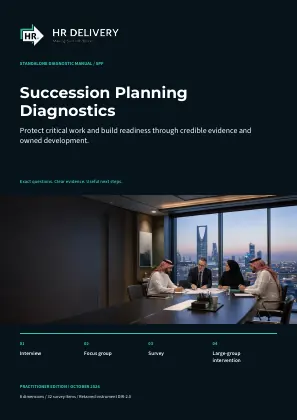
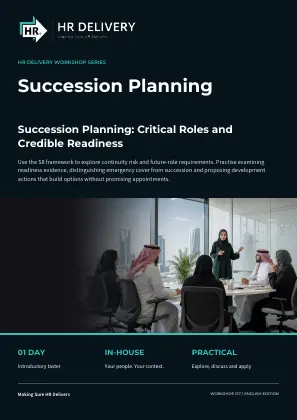
Bring the evidence into your workspace.
The existing Learning and Development tools support role evidence, individual plans and authorised reports. Strategic decisions, calibration and approvals remain with the accountable people. Organisation records require authorised access; private manager invitations retain their assigned scope.
Open Succession Planning