
Clearer role expectations
Describe the work, responsibilities and capabilities needed at each level.
TALENTMAPS³ · FROM EXPECTATIONS TO ACTION
TalentMaps³ brings role expectations, people evidence, development and performance into one practical approach. Use the maps to describe what good looks like, then choose the resources and portal tools that help you put it into practice.
Describe the work, responsibilities and capabilities needed at each level.
Bring role information and relevant evidence to workforce, reward and performance discussions.
Turn identified needs into learning priorities, individual plans and useful review conversations.
START WITH YOUR CONTEXT
Explore the complete architecture or the pathway for individual contributors, managers or leaders. Each opens its framework, documents and assessment information.
Connect all three pathways, explore the shared architecture and open the complete resource library.
Standards, Support and Self-Management. Everything for the Individual Contributor Talent Map³.
Productivity, People and Performance. Everything for the Manager Talent Map³.
Direction, Development and Delivery. Everything for the Leader Talent Map³.
Choose a map to explore its framework, documents and assessment options in one place.
THE PORTAL, EXPLAINED
These are the five groups in the TalentMaps³ portal menu. Start with the area relevant to your task, and use the shared resources throughout. Sign in to work with the portal tools.
Work towards clear role descriptions, consistent evaluation, considered pay decisions and a documented workforce plan.
Identify priorities, prepare individual development plans and choose relevant coaching, workshops and learning materials.
Maintain role-linked people records, agree objectives and reviews, and consider readiness for critical roles with HR.
Prepare focused surveys, explore engagement and wellbeing benchmarks, and identify questions for improvement.
Use the original documents and user guides alongside the tools. The three TalentMap assessment suites are listed as planned.
YOUR NEXT STEP
Read the public library, sign in to the portal or talk to HR Delivery about access for your organisation.
THE COMPLETE ARCHITECTURE
Connect all three pathways, explore the shared architecture and open the complete resource library.
SECTION A
Understand the framework, maturity levels and capabilities that connect this Talent Map.
Start with your roles and organisational priorities, select the pathways, calibrate expectations, pilot the approach and review its application.
Read the combined manual, presentation, maturity map, career families guide and behavioural competency dictionaries for all three frameworks in our PDF viewer.
Explore the complete architecture across the 3S9C, 3P9C and 3D9C pathways, including maturity maps, competencies and behavioural indicators.
View manualIntroduce the complete Talent Map³ architecture and explain how the Individual Contributor, Manager and Leader pathways connect.
View presentationRoles, rewards, assessment and development, connected across all three pathways.
Open a section to explore the full scope. Each Talent Map shows the documents and tools that are currently available or planned.
Practical guidance and support to establish your Talent Map, choose the pathways, calibrate expectations and plan implementation.
See how the Individual Contributor, Manager and Leader frameworks connect across the organisation.
Clarify expectations at each level and align them with your grades and progression gateways.
Group related roles and make specialist, management and leadership progression routes easier to understand.
Describe effective behaviours through clear competency definitions, practical indicators and evidence at each level.
Define the professional knowledge and technical skills each career family needs, aligned to role requirements and defined career paths.
Bring roles, career families and levels into a consistent classification, with the complete guide and family sections.
Shape how work, accountability and reporting relationships support your operating model and organisational priorities.
Explore reporting layers, management capacity and organisation charts to support informed design decisions.
Find approved job descriptions by section, career family and grade, covering purpose, responsibilities, scope and behavioural and technical requirements.
Evaluate new or changing roles using structured evidence and consistent criteria, supporting well-founded grading decisions as your organisation evolves.
Build a shared reference for role responsibilities and practical duties, aligned with career families and levels.
Explore salary reference data across the six Gulf countries and career families to inform your organisation’s pay decisions.
Develop salary bands aligned to your organisation’s grades, career families and reward priorities.
Document the principles behind pay decisions, including internal consistency, market position and progression.
Develop a connected reward strategy covering pay, benefits, recognition and development as part of the employee experience.
Explore working arrangements that balance employee needs, role requirements and operational continuity.
Explore relevant experience, motivation and initial role fit through a consistent opening conversation.
Explore how working preferences and values relate to the organisation’s culture and expectations.
Understand learning preferences to inform a varied development approach, alongside evidence of capability.
Use structured questions to explore real examples, individual contribution and evidence of outcomes.
Explore responses to realistic workplace situations matched to the pathway’s behavioural competencies.
Explore professional judgement in scenarios relevant to the career family, role and technical requirements.
Bring behavioural and technical evidence together against the requirements of an agreed role profile.
Support reflection on current practice, strengths and priorities, using examples from work.
Gather feedback from relevant colleagues across all staff groups, using 270 or 360 degree approaches appropriate to each pathway.
Explore preferred areas of contribution within the framework; interpret preferences separately from demonstrated competence.
Connect behavioural priorities with practical activities, courses, reading, listening and viewing resources.
Build career-family expertise through structured technical learning, workplace application and evidence of progress.
Turn assessment findings and career goals into agreed actions, support, application opportunities and review dates.
Support the transition from individual contributor to manager, and from manager to leader, with clear expectations and practical preparation for each step.
Offer practical workshops covering all 27 behavioural competencies across the Individual Contributor, Manager and Leader frameworks.
Provide online coaching connected to the Talent Maps, helping people reflect, plan actions and apply learning at work, with AI support where agreed.
Identify and prioritise training needs at individual, team, directorate and organisation levels by comparing role requirements with assessment evidence.
Help newly formed teams clarify roles, build working relationships and establish effective routines after structural change.
Make progression routes clear across career families, showing the experience, competencies and development needed for the next step.
Identify critical roles, consider potential successors and agree development priorities and review points.
Organise role requirements, successor evidence, readiness and development actions to support informed review conversations.
Agree clear objectives and role expectations, hold constructive reviews and connect progress with development and support.
CHOOSE THE RIGHT STARTING POINT
Use one pathway or connect all three. Each brings its own expectations and development focus; people do not need to become managers to demonstrate expertise or make an important contribution.
For people who deliver through their own expertise, service and everyday contribution.
Explore this pathwayFor supervisors, team leaders and managers accountable for people and day-to-day results.
Explore this pathwayFor leaders shaping strategic choices, organisational capability and performance across boundaries.
Explore this pathwayA COMPLETE VIEW OF TALENT
A framework becomes valuable when people can use it. Talent Map³ connects what a role requires, how capability develops, how it is explored and what a person can do next. We adapt the architecture to your organisation’s language, roles, grades and priorities.
Evidence from application feeds the next conversation, the next review and the next development choice.
THE CONNECTED BUILDING BLOCKS
Agree the components your organisation needs, then connect them into a practical service. The resources below provide starting points; pathway-specific configuration, assessment fit and grade mapping are confirmed during design.
Start with the purpose of the pathway and a clear model of effective contribution, management or leadership. Use the relevant three-domain, nine-competency framework as a common language.
Compare the frameworksDescribe how expectations change as work becomes more complex, independent and influential. Define observable evidence at each level so people can understand both their current contribution and the next step.
Explore maturity models · PortalMap the agreed maturity levels to your organisation’s grades through role analysis and calibration. Consider accountability, decision scope and job evaluation; a framework level is not an automatic pay grade or promotion.
Explore job evaluationBring behavioural expectations and career-family technical skills together in a role profile. Define the required level, practical indicators and the work evidence needed to demonstrate each competency.
Explore competency architectureGroup roles with related professional work and expertise. Agree each family’s purpose, technical capabilities and progression logic, then adapt the existing libraries to your operating model.
Explore career families · PortalMake potential moves visible within and between families, including specialist, management and leadership opportunities. Describe transition requirements, experience and evidence, so the conversation goes beyond the next job title.
Explore career pathwaysTurn the architecture into usable role documents: purpose, accountabilities, scope, working relationships and capability requirements. Check each description with the people responsible for the work.
Open the job description provider · PortalChoose competency interviews, situational judgement, self-assessment, 360 feedback and technical-skill assessments to suit the question being explored. Agree the role, framework and level first; combine evidence rather than treating one score as the whole answer.
Explore the assessment approachConnect each priority to useful courses, workplace activities, reading, listening and viewing. Build a practical development manual around the selected pathway, with instructions, application tasks and evidence of progress.
Explore learning resourcesTranslate assessment and career priorities into an individual development plan. Agree specific actions, support, application opportunities and review dates, then revisit the evidence at 30, 60 and 90 days.
Open the IDP tool · PortalExplore how AI-supported coaching could help people reflect on feedback, think through challenges and prepare development conversations. The current AI coaching page is a preview; agree the available support before designing a programme.
Explore AI coaching · PreviewLinks marked Portal open the Assessment Department Portal and may require access. Existing portal libraries have Professional and Para-professional pathways; the three Talent Map³ pathways are tailored as part of an agreed implementation.
See how all three frameworks connect across the 13-grade architecture.
View maturity mapHR Delivery career families group roles with related work and specialist expertise. Explore ten sections and 100 technical competencies to connect role requirements, skills and career development across all three Talent Map³ pathways.
View career familiesThe combined 3S9C, 3P9C and 3D9C dictionary: 27 competencies and 135 level checklists across all three pathways.
View complete dictionaryAn executive introduction to the shared behavioural competency architecture for individual contributors, managers and leaders.
View executive briefingExplore the ten technical sections across the complete architecture. All ten A–J directories are available to read in our PDF viewer.
SECTION B
Connect roles, grades and organisation structure with the resources and tools below.
Explore job classification across 100 career families, with a shared maturity map connecting Individual Contributor, Manager and Leader roles. Choose the complete guide or a career-family section from the same menu.
A dedicated Organisation Design Process document is coming soon. The existing Structure Studio supports exploring reporting layers, management capacity and organisation charts.
Guidance on purposeful reporting layers, workable spans of control and the 13-grade organisation architecture.
TALENTMAPS³ / ORGANISATION INFRASTRUCTURE
Connect thirteen grades with purposeful reporting layers and manageable spans. Use five connected tools, then explore the method, guides and editable workbooks.
Test headcount, management capacity and reporting layers for an organisation, directorate or team.
Open the modeller ↗Build and validate reporting relationships and view a branded organisation chart. Sign in to the portal to export it.
Create a chart ↗Describe a role, evaluate its demands and view a provisional grading report. Sign in to save evaluations and download reports.
Enter Job Evaluation ↗Find a role by section, career family and grade. View approved job descriptions. Sign in to download individual descriptions and selected packs.
Enter the Job Description Bank ↗Plan workforce demand and supply, compare scenarios and connect staffing gaps with costs and actions.
Open Workforce Planning ↗Public studio: view documents and explore tools online. Downloads are available only after signing in to the Talent Maps department portal. Structure data stays in this browser tab until you save it from the signed-in portal.
PDF · ENGLISH
The complete architecture, evidence, guiding principles and 10,000-person example.
View document ↗EXCEL · ENGLISH
Editable assumptions, integer layer scenarios and the cost and capacity bridge.
Sign in for downloads →PDF · ENGLISH
Step-by-step guidance for the web and Excel modeller.
View document ↗EXCEL · ENGLISH
Position entry, reporting checks, printable hierarchy and compact chart.
Sign in for downloads →PDF · ENGLISH
Import, validation, branch views and branded PDF export.
View document ↗PDF · ENGLISH
Three branded views: the overview and two functional branches.
View document ↗CSV · ENGLISH
Example positions, ready to import into the web chart creator.
Sign in for downloads →ZIP · ENGLISH
All PDFs, both Excel tools and the CSV example in one download.
Sign in for downloads →Explore how the Talent Maps architecture connects role purpose, responsibilities, capability and governance to create clear, maintainable job descriptions.
Find a role by section, career family and grade in the TalentMaps³ Job Description Bank. View the original job descriptions in the document viewer. Sign in to the Talent Maps Department Portal to download documents or create combined packs.
A complete guide to the job evaluation approach, role evidence, scoring criteria and practical application.
Complete a Job Evaluation online without portal sign-in and download a provisional report or Excel workbook. Use the Talent Maps Department Portal to keep saved role evaluations. The existing methodology, grade criteria, workbooks, example report and manager guide remain available in the web tool.
The complete duties and responsibilities reference for 100 career families and 1,300 graded roles across sections A–J.
SECTION C
Choose country salary guides or career-family references. Complete guides and A–J sections remain together in each menu.
Choose a country to explore job classifications and proposed salary scales for career families A–J. The figures are planning examples rather than independently verified market benchmarks.
Explore the complete salary reference for 100 career families, 13 HR Delivery grades and six Gulf countries. Compare the proposed monthly basic-pay bands, role profiles and package guidance across the full A–J collection.
Explore the A–J guide to HR Delivery grades and proposed monthly basic-salary bands across six GCC countries, with role profiles, methodology and package guidance. The bands are illustrative proposals, not market benchmarks.
Choose any of the ten individual career-family manuals or the complete A–J guide from the same menu.
Set a clear approach to market positioning, salary bands, contribution and reward decisions.
Explore the complete employment offer, including pay, benefits, wellbeing and reward options across the Gulf.
Explore flexible working arrangements, country perspectives and practical implementation across the Gulf.
SECTION D
Ten assessment options, organised in the same order for every Talent Map. Planned tools and supporting documents are clearly marked.
UNDERSTAND CAPABILITY
Choose methods for the decision or development question. Interviews, scenarios and feedback can complement one another, but each instrument needs the right framework, role and level. Preferences are not the same as demonstrated capability.
Explore real examples, the person’s contribution and the evidence behind an outcome. Use structured questions and trained assessor judgement.
Explore assessment optionsExplore choices in realistic situations and discuss the reasoning behind them. Match scenarios to the intended role and competency framework.
Explore assessment optionsGive people a structured way to consider their own practice. Explore preferences and examples alongside evidence from work and other perspectives.
Explore assessment optionsCompare self perception with feedback from agreed contributors. Define confidentiality, participation and a constructive debrief before collection.
Explore assessment optionsReview the specialist capability required by the role and career family. Use relevant level expectations, scenarios and practical work evidence.
Explore assessment optionsSECTION E
Move from assessment evidence to practical learning, support and a focused development plan.
Choose the complete behavioural development manual or the original manual for Individual Contributors, Managers or Leaders.
Develop technical capability across all ten career-family sections. The complete A–J collection covers 100 competencies and 1,000 named skills, with learning resources, practical activities, self-assessments and planning tools.
Choose any of the ten individual career-family manuals or the complete A–J collection from the same menu. All documents are English PDFs.
Translate priorities into actions, support and review dates using the existing individual development plan builder. Department portal access may be required.
Dedicated Talent Map gateway programme documents are coming soon. Explore the current development programmes and workshops.
Explore the current competency learning resources, courses, reading, listening and viewing. Select resources for the role and agreed development priority.
Open the complete TalentMaps³ coaching library in the portal ↗
Explore coaching and supported application. The AI coaching page remains a preview, with available support agreed during programme design.
Use the shared portal entry for training needs analysis. The portal identifies the module’s current availability.
TURN INSIGHT INTO PRACTICE
A useful plan connects a real priority to learning, support and opportunities to practise. Combine the appropriate resources, agree what will change at work and return to the evidence.
Explore behavioural and technical resources, then select material relevant to the role and development priority.
Explore resourcesCombine facilitated learning with practice and a workplace challenge. Explore management, leadership and broader development options.
Explore resourcesUse the practitioner libraries to build a varied learning route. Choose resources for a specific outcome and plan how to apply them.
Explore resourcesCreate space to interpret feedback, rehearse conversations and review progress. Explore coaching with our team alongside the AI coaching preview.
Explore resourcesSECTION F
Connect capability gaps with recruitment evidence and succession planning.
The Talent Map recruitment tools are coming soon. Review the planned first-stage interview, cultural match and competency interview resources in Assessment.
Enter the shared Talent Maps Department Portal for succession planning. The portal identifies the module’s current availability.
SECTION G
Connect expectations, evidence and review with performance conversations.
BUILT WITH YOUR ORGANISATION
Confirm the workforce, roles, existing frameworks and decisions the architecture needs to support.
Select the pathways, define levels, map grades and test role profiles with your stakeholders.
Try the assessment and development approach with a focused group; refine wording, usability and interpretation.
Equip managers, connect individual plans to work, and review application, progress and the architecture itself.
SECTION H
Supporting references that sit outside sections A–G are kept here. All existing documents have been allocated to those sections; none are awaiting a home.
All current document collections have a place in sections A–G. Additional supporting documents will be added here as they become available.
The complete example collection, also available beside each topic’s resources.
SEE THE OUTPUT
Explore the results before you begin. Each example opens in the viewer; the complete manuals and presentations remain under their relevant topics.
PATHWAY 01 / 3S9C
Reliable contribution. Visible growth.
For people who deliver through their own expertise, service and everyday contribution.
SECTION A
Understand the framework, maturity levels and capabilities that connect this Talent Map.
Start with your roles and organisational priorities, select the pathways, calibrate expectations, pilot the approach and review its application.
Read the manual, presentation, maturity map, behavioural competency guide and development manual in our PDF viewer.
Explore the 3S9C behavioural competency model, its maturity levels and detailed behavioural indicators.
View manualUse the presentation companion to introduce the framework and explain the Individual Contributor pathway.
View presentationBuild a clear development route for people whose impact comes through the work they do, rather than responsibility for managing others. Connect role expectations, technical capability and observable behaviours with meaningful opportunities to grow.
Use the five contribution stages—Foundation, Developing, Capable, Advanced and Expert—to discuss consistency, independence and complexity. Calibrate the stages to real roles; progression can deepen expertise without requiring a move into management.
The outcomeA practical picture of effective contribution, evidence of current capability and a focused next step in development.
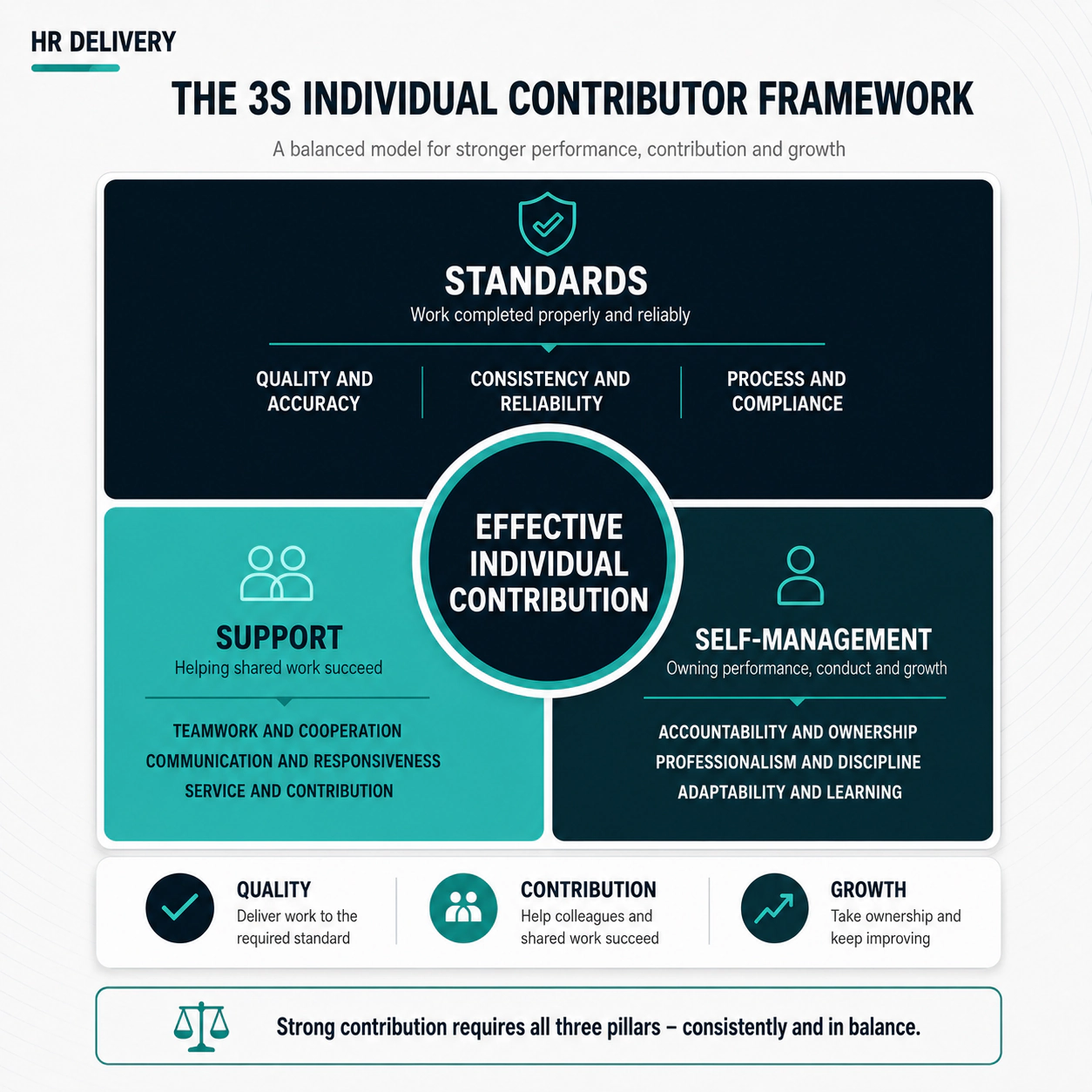
Shared from the Overall Talent Map.
Explore the five maturity levels and expectations for grades 1–5.
View maturity mapShared from the Overall Talent Map.
HR Delivery career families group roles with related work and specialist expertise. Explore ten sections and 100 technical competencies to connect role requirements, skills and career development across all three Talent Map³ pathways.
View career familiesShared from the Overall Talent Map.
Explore nine competencies across five maturity levels, with 45 practical checklists, positive behaviours and watchouts.
View behavioural guideShared from the Overall Talent Map.
Build the specialist expertise needed to deliver confident, dependable work. These career-family guides complement the 3S9C behavioural framework with practical technical skills and observable expectations.
Choose the sections relevant to the role, then use T1 Foundation, T2 Developing and T3 Solid to agree expectations, review work evidence and identify development priorities. Each section contains ten competencies and 100 technical skills.
SECTION B
Connect roles, grades and organisation structure with the resources and tools below.
Shared from the Overall Talent Map.
Use these shared job classification booklets alongside your 3S9C framework. The same guides support all three Talent Map pathways, connecting career-family roles with grade and maturity expectations.
A dedicated Organisation Design Process document is coming soon. The existing Structure Studio supports exploring reporting layers, management capacity and organisation charts.
Shared from the Overall Talent Map.
TALENTMAPS³ / ORGANISATION INFRASTRUCTURE
Connect thirteen grades with purposeful reporting layers and manageable spans. Use five connected tools, then explore the method, guides and editable workbooks.
Test headcount, management capacity and reporting layers for an organisation, directorate or team.
Open the modeller ↗Build and validate reporting relationships and view a branded organisation chart. Sign in to the portal to export it.
Create a chart ↗Describe a role, evaluate its demands and view a provisional grading report. Sign in to save evaluations and download reports.
Enter Job Evaluation ↗Find a role by section, career family and grade. View approved job descriptions. Sign in to download individual descriptions and selected packs.
Enter the Job Description Bank ↗Plan workforce demand and supply, compare scenarios and connect staffing gaps with costs and actions.
Open Workforce Planning ↗Public studio: view documents and explore tools online. Downloads are available only after signing in to the Talent Maps department portal. Structure data stays in this browser tab until you save it from the signed-in portal.
PDF · ENGLISH
The complete architecture, evidence, guiding principles and 10,000-person example.
View document ↗EXCEL · ENGLISH
Editable assumptions, integer layer scenarios and the cost and capacity bridge.
Sign in for downloads →PDF · ENGLISH
Step-by-step guidance for the web and Excel modeller.
View document ↗EXCEL · ENGLISH
Position entry, reporting checks, printable hierarchy and compact chart.
Sign in for downloads →PDF · ENGLISH
Import, validation, branch views and branded PDF export.
View document ↗PDF · ENGLISH
Three branded views: the overview and two functional branches.
View document ↗CSV · ENGLISH
Example positions, ready to import into the web chart creator.
Sign in for downloads →ZIP · ENGLISH
All PDFs, both Excel tools and the CSV example in one download.
Sign in for downloads →Shared from the Overall Talent Map.
Find a role by section, career family and grade in the TalentMaps³ Job Description Bank. View the original job descriptions in the document viewer. Sign in to the Talent Maps Department Portal to download documents or create combined packs.
Shared from the Overall Talent Map.
Complete a Job Evaluation online without portal sign-in and download a provisional report or Excel workbook. Use the Talent Maps Department Portal to keep saved role evaluations. The existing methodology, grade criteria, workbooks, example report and manager guide remain available in the web tool.
Shared from the Overall Talent Map.
The complete duties and responsibilities reference for 100 career families and 1,300 graded roles across sections A–J.
SECTION C
Choose country salary guides or career-family references. Complete guides and A–J sections remain together in each menu.
Shared from the Overall Talent Map.
Choose a country to explore job classifications and proposed salary scales for career families A–J. The figures are planning examples rather than independently verified market benchmarks.
Explore the complete salary reference for 100 career families, 13 HR Delivery grades and six Gulf countries. Compare the proposed monthly basic-pay bands, role profiles and package guidance across the full A–J collection.
Shared from the Overall Talent Map.
Explore the A–J guide to HR Delivery grades and proposed monthly basic-salary bands across six GCC countries, with role profiles, methodology and package guidance. The bands are illustrative proposals, not market benchmarks.
Choose any of the ten individual career-family manuals or the complete A–J guide from the same menu.
Shared from the Overall Talent Map.
Set a clear approach to market positioning, salary bands, contribution and reward decisions.
Shared from the Overall Talent Map.
Explore the complete employment offer, including pay, benefits, wellbeing and reward options across the Gulf.
Shared from the Overall Talent Map.
Explore flexible working arrangements, country perspectives and practical implementation across the Gulf.
SECTION D
Ten assessment options, organised in the same order for every Talent Map. Planned tools and supporting documents are clearly marked.
Use an initial structured conversation to explore relevant experience, motivation and understanding of the role. Review early examples of reliable contribution, collaboration and personal ownership, clarify role expectations and identify evidence to explore in later interviews or assessments.
Resources coming soon
Explore alignment between the organisation’s stated workplace values, everyday working practices and the expectations of the role. Use scenarios and examples linked to reliable contribution, collaboration and personal ownership to discuss strengths, differences and support needs. Compare evidence against clear job-related criteria alongside the wider assessment picture.
Resources coming soon
Explore how someone prefers to approach learning, practise new skills and receive support. Use the discussion to select a varied mix of development activities, then review which approaches help the person apply learning effectively at work.
Resources coming soon
Use structured questions to explore examples of reliable work, helpful collaboration and personal ownership. Interview prompts, follow-up probes and evidence criteria would support consistent conversations about the nine 3S9C competencies and the expectations of the individual’s role.
Resources coming soon
Explore responses to realistic situations involving quality, service, teamwork and self-management. Participants would consider possible actions and their consequences, providing a structured starting point for discussing behavioural judgement and development priorities across Standards, Support and Self-Management.
Resources coming soon
Explore how an individual applies specialist knowledge when faced with practical career-family decisions. Role-relevant scenarios would examine priorities, technical choices and appropriate escalation, with expectations aligned to the selected technical skills and the level required by the role.
Resources coming soon
Bring observable 3S9C behaviours and career-family technical skills into one assessment approach. Practical tasks, work examples and structured evidence review would help identify where an individual can contribute confidently and where further practice, guidance or development is needed.
Resources coming soon
Reflect on current contribution against the nine 3S9C competencies using recent examples of work. Self-ratings and evidence notes would help the individual prepare for a development conversation, compare expectations and choose a small number of meaningful improvement priorities.
Resources coming soon
Bring together perspectives from the individual, their manager and colleagues who know their work. Feedback would explore everyday contribution across Standards, Support and Self-Management, highlighting patterns to discuss, strengths to build on and practical actions for development.
Resources coming soon
Explore where an individual naturally directs attention across Standards, Support and Self-Management. The profile would support reflection on preferred ways of contributing, opportunities to broaden experience and the balance a role needs; demonstrated capability would be considered separately.
Resources coming soon
3S9C · ASSESSMENT SUITE
A planned collection of ten tools to explore individual contribution, career-family expertise and development priorities through the 3S9C framework. Select methods that fit the role and combine evidence to build a practical development picture.
Explore our planned assessment suite below. These draft descriptions will develop as the tools are created. Factsheets, example reports and assessment access will be added here when ready.
SECTION E
Move from assessment evidence to practical learning, support and a focused development plan.
Shared from the Overall Talent Map.
Learning resources, practical activities and development worksheets for all nine 3S9C competencies.
View development manualShared from the Overall Talent Map.
Develop technical capability across all ten career-family sections. The complete A–J collection covers 100 competencies and 1,000 named skills, with learning resources, practical activities, self-assessments and planning tools.
Choose any of the ten individual career-family manuals or the complete A–J collection from the same menu. All documents are English PDFs.
Translate priorities into actions, support and review dates using the existing individual development plan builder. Department portal access may be required.
Dedicated Talent Map gateway programme documents are coming soon. Explore the current development programmes and workshops.
Explore the current competency learning resources, courses, reading, listening and viewing. Select resources for the role and agreed development priority.
Open the complete TalentMaps³ coaching library in the portal ↗
Explore coaching and supported application. The AI coaching page remains a preview, with available support agreed during programme design.
Use the shared portal entry for training needs analysis. The portal identifies the module’s current availability.
Shared from the Overall Talent Map.
SECTION F
Connect capability gaps with recruitment evidence and succession planning.
The Talent Map recruitment tools are coming soon. Review the planned first-stage interview, cultural match and competency interview resources in Assessment.
Enter the shared Talent Maps Department Portal for succession planning. The portal identifies the module’s current availability.
SECTION G
Connect expectations, evidence and review with performance conversations.
Follow the shared setup and implementation process, calibrated to this pathway and your organisation.
Read the implementation processSECTION H
Supporting references that sit outside sections A–G are kept here. All existing documents have been allocated to those sections; none are awaiting a home.
All current document collections have a place in sections A–G. Additional supporting documents will be added here as they become available.
The complete example collection, also available beside each topic’s resources.
PATHWAY 02 / 3P9C
Organise the work. Enable the team.
For supervisors, team leaders and managers accountable for people and day-to-day results.
SECTION A
Understand the framework, maturity levels and capabilities that connect this Talent Map.
Start with your roles and organisational priorities, select the pathways, calibrate expectations, pilot the approach and review its application.
Read the manual, presentation, maturity map, behavioural competency guide and development manual in our PDF viewer.
Explore the 3P9C behavioural competency model, its maturity levels and detailed behavioural indicators.
View manualUse the presentation companion to introduce the framework and explain the Manager pathway.
View presentationHelp managers move from individual expertise to effective management practice. Make expectations clear across workload, people and performance, then use evidence and supported practice to strengthen the routines that shape a team’s experience.
Start with a real team challenge. Agree the management behaviours required, choose suitable assessment methods and practise planning, delegation, coaching and feedback. Confirm any assessment’s fit to 3P9C before using it for a development or selection decision.
The outcomeClear management expectations, better conversations and practical routines for coordinating people and delivering results.
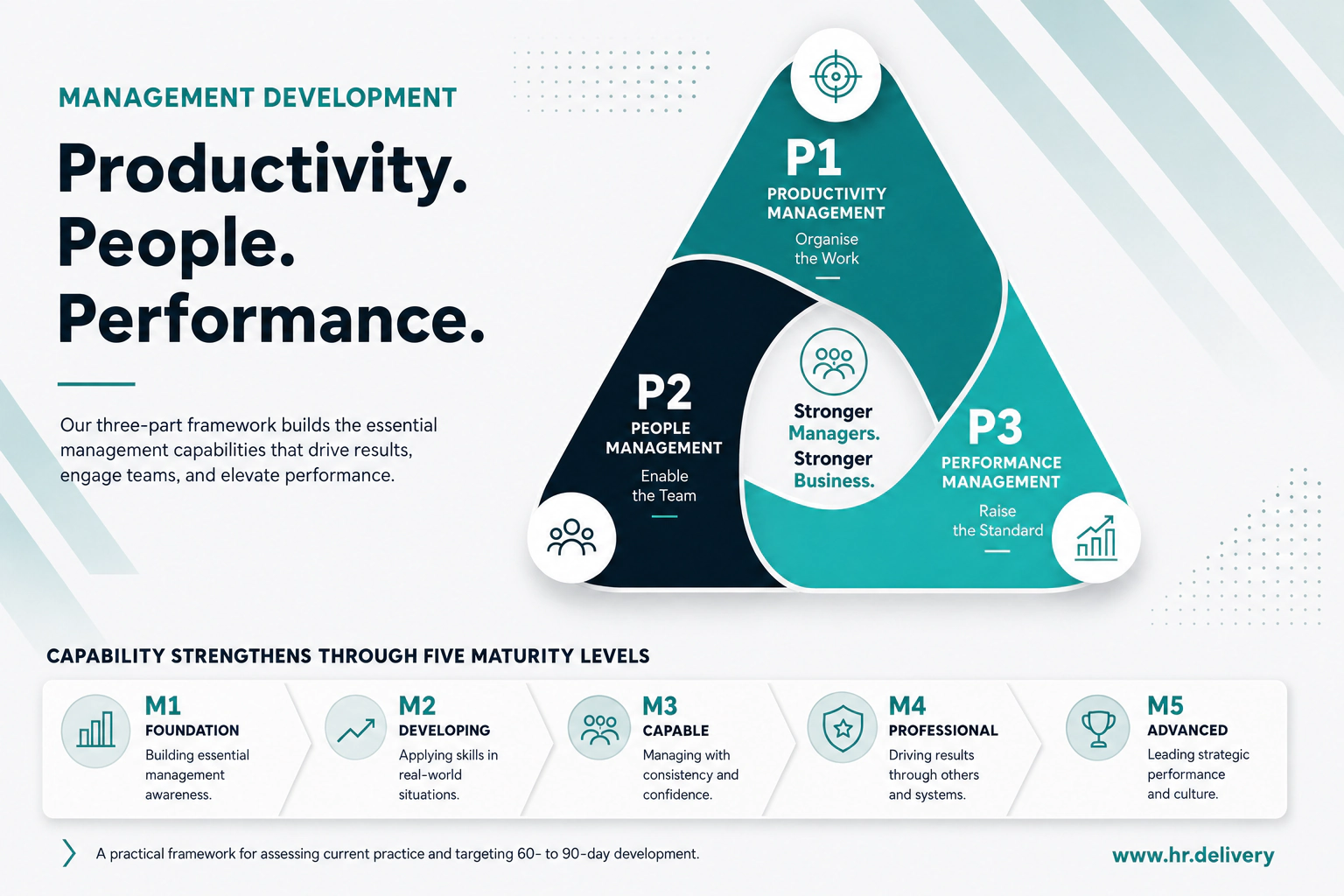
Shared from the Overall Talent Map.
Explore the five maturity levels and expectations for grades 4–8.
View maturity mapShared from the Overall Talent Map.
HR Delivery career families group roles with related work and specialist expertise. Explore ten sections and 100 technical competencies to connect role requirements, skills and career development across all three Talent Map³ pathways.
View career familiesShared from the Overall Talent Map.
Explore nine competencies across five maturity levels, with 45 practical checklists, positive behaviours and watchouts.
View behavioural guideShared from the Overall Talent Map.
Connect specialist expertise with effective management. These career-family guides support planning work, making informed operational decisions, assuring quality and developing the team's capability alongside the 3P9C behavioural framework.
Choose the technical areas relevant to the manager's function. Use T1 Foundation, T2 Developing, T3 Solid and T4 Advanced to agree role expectations, review work evidence and prioritise development. These are technical proficiency levels, separate from the M1–M5 Manager career levels.
SECTION B
Connect roles, grades and organisation structure with the resources and tools below.
Shared from the Overall Talent Map.
Use these shared job classification booklets alongside your 3P9C framework. The same guides support all three Talent Map pathways, connecting career-family roles with grade and maturity expectations.
A dedicated Organisation Design Process document is coming soon. The existing Structure Studio supports exploring reporting layers, management capacity and organisation charts.
Shared from the Overall Talent Map.
TALENTMAPS³ / ORGANISATION INFRASTRUCTURE
Connect thirteen grades with purposeful reporting layers and manageable spans. Use five connected tools, then explore the method, guides and editable workbooks.
Test headcount, management capacity and reporting layers for an organisation, directorate or team.
Open the modeller ↗Build and validate reporting relationships and view a branded organisation chart. Sign in to the portal to export it.
Create a chart ↗Describe a role, evaluate its demands and view a provisional grading report. Sign in to save evaluations and download reports.
Enter Job Evaluation ↗Find a role by section, career family and grade. View approved job descriptions. Sign in to download individual descriptions and selected packs.
Enter the Job Description Bank ↗Plan workforce demand and supply, compare scenarios and connect staffing gaps with costs and actions.
Open Workforce Planning ↗Public studio: view documents and explore tools online. Downloads are available only after signing in to the Talent Maps department portal. Structure data stays in this browser tab until you save it from the signed-in portal.
PDF · ENGLISH
The complete architecture, evidence, guiding principles and 10,000-person example.
View document ↗EXCEL · ENGLISH
Editable assumptions, integer layer scenarios and the cost and capacity bridge.
Sign in for downloads →PDF · ENGLISH
Step-by-step guidance for the web and Excel modeller.
View document ↗EXCEL · ENGLISH
Position entry, reporting checks, printable hierarchy and compact chart.
Sign in for downloads →PDF · ENGLISH
Import, validation, branch views and branded PDF export.
View document ↗PDF · ENGLISH
Three branded views: the overview and two functional branches.
View document ↗CSV · ENGLISH
Example positions, ready to import into the web chart creator.
Sign in for downloads →ZIP · ENGLISH
All PDFs, both Excel tools and the CSV example in one download.
Sign in for downloads →Shared from the Overall Talent Map.
Find a role by section, career family and grade in the TalentMaps³ Job Description Bank. View the original job descriptions in the document viewer. Sign in to the Talent Maps Department Portal to download documents or create combined packs.
Shared from the Overall Talent Map.
Complete a Job Evaluation online without portal sign-in and download a provisional report or Excel workbook. Use the Talent Maps Department Portal to keep saved role evaluations. The existing methodology, grade criteria, workbooks, example report and manager guide remain available in the web tool.
Shared from the Overall Talent Map.
The complete duties and responsibilities reference for 100 career families and 1,300 graded roles across sections A–J.
SECTION C
Choose country salary guides or career-family references. Complete guides and A–J sections remain together in each menu.
Shared from the Overall Talent Map.
Choose a country to explore job classifications and proposed salary scales for career families A–J. The figures are planning examples rather than independently verified market benchmarks.
Explore the complete salary reference for 100 career families, 13 HR Delivery grades and six Gulf countries. Compare the proposed monthly basic-pay bands, role profiles and package guidance across the full A–J collection.
Shared from the Overall Talent Map.
Explore the A–J guide to HR Delivery grades and proposed monthly basic-salary bands across six GCC countries, with role profiles, methodology and package guidance. The bands are illustrative proposals, not market benchmarks.
Choose any of the ten individual career-family manuals or the complete A–J guide from the same menu.
Shared from the Overall Talent Map.
Set a clear approach to market positioning, salary bands, contribution and reward decisions.
Shared from the Overall Talent Map.
Explore the complete employment offer, including pay, benefits, wellbeing and reward options across the Gulf.
Shared from the Overall Talent Map.
Explore flexible working arrangements, country perspectives and practical implementation across the Gulf.
SECTION D
Ten assessment options, organised in the same order for every Talent Map. Planned tools and supporting documents are clearly marked.
Use an initial structured conversation to explore relevant experience, motivation and understanding of the role. Review early examples of organising work, supporting people and managing performance, clarify role expectations and identify evidence to explore in later interviews or assessments.
Resources coming soon
Explore alignment between the organisation’s stated workplace values, everyday working practices and the expectations of the role. Use scenarios and examples linked to organising work, supporting people and managing performance to discuss strengths, differences and support needs. Compare evidence against clear job-related criteria alongside the wider assessment picture.
Resources coming soon
Explore how someone prefers to approach learning, practise new skills and receive support. Use the discussion to select a varied mix of development activities, then review which approaches help the person apply learning effectively at work.
Resources coming soon
Explore real examples of organising work, supporting people and improving team performance. Structured interview questions, follow-up probes and evidence criteria would help assessors examine the manager’s own actions, decisions and results across the nine 3P9C competencies.
Resources coming soon
Explore decisions in realistic management situations involving competing priorities, team support, accountability and feedback. Participants would weigh possible responses and their implications, supporting a development discussion across Productivity Management, People Management and Performance Management in everyday team leadership.
Resources coming soon
Examine how a manager applies professional knowledge to operational choices, quality assurance and team delivery. Career-family scenarios would explore trade-offs, risk, resources and escalation, using the technical expectations appropriate to the manager’s function, responsibilities and decision-making authority.
Resources coming soon
Combine evidence of 3P9C management behaviours with the technical skills needed to oversee a function. Practical exercises and structured evidence review would explore planning, people decisions and specialist judgement, producing a clearer basis for targeted management development.
Resources coming soon
Review current management practice against the nine 3P9C competencies, supported by recent examples and results. Self-ratings would help managers identify consistent strengths, examine gaps between intention and practice, and agree focused development actions with their own manager or coach.
Resources coming soon
Compare the manager’s perspective with feedback from their manager, peers and direct reports. The proposed process would explore how management behaviours are experienced across Productivity, People and Performance, supporting constructive conversations and practical development actions grounded in recurring feedback patterns.
Resources coming soon
Explore the manager’s preferred focus across Productivity Management, People Management and Performance Management. Use the profile to discuss working habits, areas that may receive less attention and ways to develop a balanced management approach, alongside separate evidence of effectiveness.
Resources coming soon
3P9C · ASSESSMENT SUITE
A planned collection of ten tools to explore management practice, specialist judgement and development priorities through the 3P9C framework. Connect the evidence to real team challenges, role expectations and the routines that help people perform.
Explore our planned assessment suite below. These draft descriptions will develop as the tools are created. Factsheets, example reports and assessment access will be added here when ready.
SECTION E
Move from assessment evidence to practical learning, support and a focused development plan.
Shared from the Overall Talent Map.
Learning resources, practical activities and development worksheets for all nine 3P9C competencies.
View development manualShared from the Overall Talent Map.
Develop technical capability across all ten career-family sections. The complete A–J collection covers 100 competencies and 1,000 named skills, with learning resources, practical activities, self-assessments and planning tools.
Choose any of the ten individual career-family manuals or the complete A–J collection from the same menu. All documents are English PDFs.
Translate priorities into actions, support and review dates using the existing individual development plan builder. Department portal access may be required.
Dedicated Talent Map gateway programme documents are coming soon. Explore the current development programmes and workshops.
Explore the current competency learning resources, courses, reading, listening and viewing. Select resources for the role and agreed development priority.
Open the complete TalentMaps³ coaching library in the portal ↗
Explore coaching and supported application. The AI coaching page remains a preview, with available support agreed during programme design.
Use the shared portal entry for training needs analysis. The portal identifies the module’s current availability.
Shared from the Overall Talent Map.
SECTION F
Connect capability gaps with recruitment evidence and succession planning.
The Talent Map recruitment tools are coming soon. Review the planned first-stage interview, cultural match and competency interview resources in Assessment.
Enter the shared Talent Maps Department Portal for succession planning. The portal identifies the module’s current availability.
SECTION G
Connect expectations, evidence and review with performance conversations.
Follow the shared setup and implementation process, calibrated to this pathway and your organisation.
Read the implementation processSECTION H
Supporting references that sit outside sections A–G are kept here. All existing documents have been allocated to those sections; none are awaiting a home.
All current document collections have a place in sections A–G. Additional supporting documents will be added here as they become available.
The complete example collection, also available beside each topic’s resources.
PATHWAY 03 / 3D9C
Set direction. Build lasting capability.
For leaders shaping strategic choices, organisational capability and performance across boundaries.
SECTION A
Understand the framework, maturity levels and capabilities that connect this Talent Map.
Start with your roles and organisational priorities, select the pathways, calibrate expectations, pilot the approach and review its application.
Read the manual, presentation, maturity map, behavioural competency guide and development manual in our PDF viewer.
Explore the 3D9C behavioural competency model, its maturity levels and detailed behavioural indicators.
View manualUse the presentation companion to introduce the framework and explain the Leader pathway.
View presentationConnect leadership expectations to the organisation’s direction and the outcomes it needs. Bring strategic judgement, people development and accountable delivery together, supported by several sources of evidence and development through consequential work.
Use structured interviews, relevant scenarios, self reflection and appropriately governed 360 feedback to build a rounded profile. Connect priorities to strategic assignments, coaching and review points. Readiness decisions remain grounded in role requirements and observed evidence.
The outcomeA shared leadership language, a rounded view of strengths and priorities, and development linked to organisational impact.
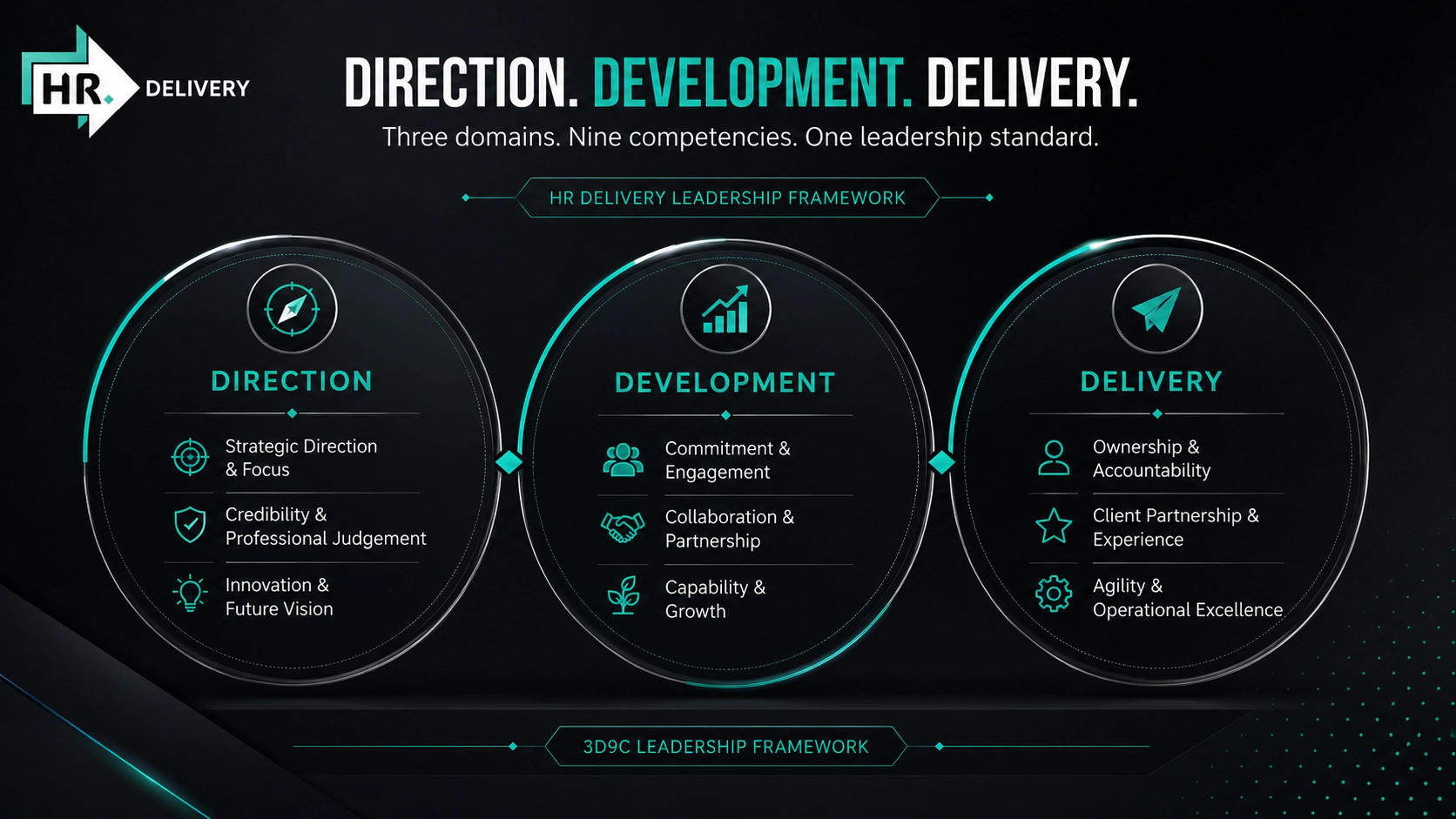
Shared from the Overall Talent Map.
Explore the five maturity levels and expectations for grades 9–13.
View maturity mapShared from the Overall Talent Map.
HR Delivery career families group roles with related work and specialist expertise. Explore ten sections and 100 technical competencies to connect role requirements, skills and career development across all three Talent Map³ pathways.
View career familiesShared from the Overall Talent Map.
Explore nine competencies across five maturity levels, with 45 practical checklists, positive behaviours and watchouts.
View behavioural guideShared from the Overall Talent Map.
Use technical understanding to shape direction, challenge assumptions and make sound enterprise decisions. These career-family guides connect strategy, investment, governance, risk and long-term capability with the 3D9C behavioural framework.
Choose the technical areas that underpin the leader's accountabilities. Use T4 Advanced and T5 Mastery to agree role expectations, review evidence from real decisions and prioritise development. Each section contains 100 technical skills. These are technical proficiency levels, separate from the L1–L5 Leader career levels.
SECTION B
Connect roles, grades and organisation structure with the resources and tools below.
Shared from the Overall Talent Map.
Use these shared job classification booklets alongside your 3D9C framework. The same guides support all three Talent Map pathways, connecting career-family roles with grade and maturity expectations.
A dedicated Organisation Design Process document is coming soon. The existing Structure Studio supports exploring reporting layers, management capacity and organisation charts.
Shared from the Overall Talent Map.
TALENTMAPS³ / ORGANISATION INFRASTRUCTURE
Connect thirteen grades with purposeful reporting layers and manageable spans. Use five connected tools, then explore the method, guides and editable workbooks.
Test headcount, management capacity and reporting layers for an organisation, directorate or team.
Open the modeller ↗Build and validate reporting relationships and view a branded organisation chart. Sign in to the portal to export it.
Create a chart ↗Describe a role, evaluate its demands and view a provisional grading report. Sign in to save evaluations and download reports.
Enter Job Evaluation ↗Find a role by section, career family and grade. View approved job descriptions. Sign in to download individual descriptions and selected packs.
Enter the Job Description Bank ↗Plan workforce demand and supply, compare scenarios and connect staffing gaps with costs and actions.
Open Workforce Planning ↗Public studio: view documents and explore tools online. Downloads are available only after signing in to the Talent Maps department portal. Structure data stays in this browser tab until you save it from the signed-in portal.
PDF · ENGLISH
The complete architecture, evidence, guiding principles and 10,000-person example.
View document ↗EXCEL · ENGLISH
Editable assumptions, integer layer scenarios and the cost and capacity bridge.
Sign in for downloads →PDF · ENGLISH
Step-by-step guidance for the web and Excel modeller.
View document ↗EXCEL · ENGLISH
Position entry, reporting checks, printable hierarchy and compact chart.
Sign in for downloads →PDF · ENGLISH
Import, validation, branch views and branded PDF export.
View document ↗PDF · ENGLISH
Three branded views: the overview and two functional branches.
View document ↗CSV · ENGLISH
Example positions, ready to import into the web chart creator.
Sign in for downloads →ZIP · ENGLISH
All PDFs, both Excel tools and the CSV example in one download.
Sign in for downloads →Shared from the Overall Talent Map.
Find a role by section, career family and grade in the TalentMaps³ Job Description Bank. View the original job descriptions in the document viewer. Sign in to the Talent Maps Department Portal to download documents or create combined packs.
Shared from the Overall Talent Map.
Complete a Job Evaluation online without portal sign-in and download a provisional report or Excel workbook. Use the Talent Maps Department Portal to keep saved role evaluations. The existing methodology, grade criteria, workbooks, example report and manager guide remain available in the web tool.
Shared from the Overall Talent Map.
The complete duties and responsibilities reference for 100 career families and 1,300 graded roles across sections A–J.
SECTION C
Choose country salary guides or career-family references. Complete guides and A–J sections remain together in each menu.
Shared from the Overall Talent Map.
Choose a country to explore job classifications and proposed salary scales for career families A–J. The figures are planning examples rather than independently verified market benchmarks.
Explore the complete salary reference for 100 career families, 13 HR Delivery grades and six Gulf countries. Compare the proposed monthly basic-pay bands, role profiles and package guidance across the full A–J collection.
Shared from the Overall Talent Map.
Explore the A–J guide to HR Delivery grades and proposed monthly basic-salary bands across six GCC countries, with role profiles, methodology and package guidance. The bands are illustrative proposals, not market benchmarks.
Choose any of the ten individual career-family manuals or the complete A–J guide from the same menu.
Shared from the Overall Talent Map.
Set a clear approach to market positioning, salary bands, contribution and reward decisions.
Shared from the Overall Talent Map.
Explore the complete employment offer, including pay, benefits, wellbeing and reward options across the Gulf.
Shared from the Overall Talent Map.
Explore flexible working arrangements, country perspectives and practical implementation across the Gulf.
SECTION D
Ten assessment options, organised in the same order for every Talent Map. Planned tools and supporting documents are clearly marked.
Use an initial structured conversation to explore relevant experience, motivation and understanding of the role. Review early examples of setting direction, developing capability and delivering organisational outcomes, clarify role expectations and identify evidence to explore in later interviews or assessments.
Resources coming soon
Explore alignment between the organisation’s stated workplace values, everyday working practices and the expectations of the role. Use scenarios and examples linked to setting direction, developing capability and delivering organisational outcomes to discuss strengths, differences and support needs. Compare evidence against clear job-related criteria alongside the wider assessment picture.
Resources coming soon
Explore how someone prefers to approach learning, practise new skills and receive support. Use the discussion to select a varied mix of development activities, then review which approaches help the person apply learning effectively at work.
Resources coming soon
Explore consequential leadership decisions and their effect on direction, people capability and organisational delivery. Structured questions and evidence probes would examine the leader’s personal contribution, judgement and learning across the nine 3D9C competencies, using examples relevant to the role.
Resources coming soon
Explore responses to complex leadership situations involving strategic choices, stakeholder expectations, capability and accountable delivery. Participants would consider competing priorities and consequences, creating a basis for discussing behavioural judgement across Direction, Development and Delivery and identifying useful development priorities.
Resources coming soon
Explore how leaders use specialist knowledge to judge investment, governance, risk and long-term capability choices. Career-family scenarios would examine technical challenge, assurance and organisational consequences, with expectations tailored to the leader’s scope, accountability and required technical proficiency.
Resources coming soon
Bring together 3D9C behavioural evidence and the technical judgement required for leadership accountabilities. Strategic exercises, work examples and structured review would explore how the leader sets direction, develops capability and delivers outcomes, informing priorities for further leadership development.
Resources coming soon
Reflect on leadership contribution against the nine 3D9C competencies using examples of decisions, relationships and outcomes. Self-ratings and evidence notes would support a focused conversation about strengths, organisational impact and the development priorities that matter most for the role.
Resources coming soon
Compare the leader’s perspective with feedback from their manager or sponsor, peers, direct reports and relevant stakeholders. The proposed process would explore experienced leadership behaviours across Direction, Development and Delivery, highlighting patterns for reflection, coaching and accountable development action.
Resources coming soon
Explore the leader’s preferred focus across Direction, Development and Delivery. Use the profile to consider how attention is distributed, where other perspectives could help and how to broaden leadership practice, while reviewing demonstrated capability and organisational outcomes through separate evidence.
Resources coming soon
3D9C · ASSESSMENT SUITE
A planned collection of ten tools to explore leadership contribution, strategic and specialist judgement, and development priorities through the 3D9C framework. Build a rounded evidence picture connected to the organisation’s direction, capability and delivery needs.
Explore our planned assessment suite below. These draft descriptions will develop as the tools are created. Factsheets, example reports and assessment access will be added here when ready.
SECTION E
Move from assessment evidence to practical learning, support and a focused development plan.
Shared from the Overall Talent Map.
Learning resources, practical activities and development worksheets for all nine 3D9C competencies.
View development manualShared from the Overall Talent Map.
Develop technical capability across all ten career-family sections. The complete A–J collection covers 100 competencies and 1,000 named skills, with learning resources, practical activities, self-assessments and planning tools.
Choose any of the ten individual career-family manuals or the complete A–J collection from the same menu. All documents are English PDFs.
Translate priorities into actions, support and review dates using the existing individual development plan builder. Department portal access may be required.
Dedicated Talent Map gateway programme documents are coming soon. Explore the current development programmes and workshops.
Explore the current competency learning resources, courses, reading, listening and viewing. Select resources for the role and agreed development priority.
Open the complete TalentMaps³ coaching library in the portal ↗
Explore coaching and supported application. The AI coaching page remains a preview, with available support agreed during programme design.
Use the shared portal entry for training needs analysis. The portal identifies the module’s current availability.
Shared from the Overall Talent Map.
SECTION F
Connect capability gaps with recruitment evidence and succession planning.
The Talent Map recruitment tools are coming soon. Review the planned first-stage interview, cultural match and competency interview resources in Assessment.
Enter the shared Talent Maps Department Portal for succession planning. The portal identifies the module’s current availability.
SECTION G
Connect expectations, evidence and review with performance conversations.
Follow the shared setup and implementation process, calibrated to this pathway and your organisation.
Read the implementation processSECTION H
Supporting references that sit outside sections A–G are kept here. All existing documents have been allocated to those sections; none are awaiting a home.
All current document collections have a place in sections A–G. Additional supporting documents will be added here as they become available.
The complete example collection, also available beside each topic’s resources.
ONE ARCHITECTURE · FOUR PRACTICAL APPLICATIONS
Once you adopt the three Talent Map³ pathways across your organisation, four additional HR processes become easier to implement. Shared roles, competencies and maturity levels give each process a clear foundation.
Use our TNA portal to turn clearly defined role expectations and assessment evidence into focused learning priorities. See where capability gaps sit and direct development towards the skills your organisation needs.
Enter the Talent Maps Department PortalWith roles, competencies and maturity levels defined, our succession portal helps you identify critical roles, assess potential successors and track the development they need to be ready for their next step.
Enter the Talent Maps Department PortalGive career transitions a clear purpose. Our gateway programmes build on the defined competencies in the Manager and Leader Talent Map³ architectures, helping people develop the capabilities required at their next level.
Explore development programmesApply HR Delivery’s Evalu8 methodology to a consistent picture of roles, responsibilities and levels. The architecture makes job design and evaluation more straightforward, supporting clearer job descriptions and well-founded grading decisions.
Enter the Talent Maps Department PortalTraining needs analysis, succession planning and job evaluation share the Talent Maps Department Portal.
YOUR ORGANISATION · YOUR TALENT MAP³
Whether you want to strengthen part of your current system or create a complete new talent framework, we can work with you to define, build and deliver the right solution for your people, strategy and ambitions.
A framework built around your strategy, values, operating model and the contribution your organisation needs.
Clear maturity levels mapped to your organisation’s grades, with expectations calibrated to your roles.
Behavioural and technical competencies defined for your organisation, with practical indicators at each level.
Connect maturity levels to your progression, promotion and career-transition gateways, with clear evidence requirements.
Career families that reflect your functions, professional disciplines and specialist roles.
Visible routes for growth within and between career families, including specialist, management and leadership options.
Job descriptions covering all employees within the agreed scope, aligned to the accountabilities and requirements of their roles.
Competency interviews, situational judgement tests, self-assessment, 360 assessment and technical skills assessment—all created by our organisational psychologists and tailored to your framework, competencies, maturity levels and roles.
Courses, practical activities and multiple sources of learning, connected to your competencies, maturity levels and development priorities.
Turn assessment findings and career goals into individual development plans using your talent map’s expectations and learning resources.
AI coaching designed around your framework, language and development approach, to support reflection, action planning and application at work.
Plan workload, capacity and workforce demand. Build scenarios that connect the roles, skills, headcount and costs your organisation needs.
Connect your career families and grades to salary structures. Compare agreed country markets, currencies and the monthly cost of recruiting different roles or a complete team.
Size roles consistently using agreed evaluation factors, connect the results to your grades and generate clear job evaluation reports.
Adapt organisation design methods, guides and editable workbooks to review how work is organised and support practical structure decisions.
Create reporting structures with either role-only positions or named employees. Keep position details and reporting lines together, with charts you can edit and export.
Explore management spans, reporting layers and structural options. Compare the shape of your organisation before agreeing changes.
Bring employee, role and organisation information into an Employee ERP workspace, connected with assessment, performance and development activity.
Build objectives, review cycles, feedback and development conversations around your Talent Map. Keep the evidence and resulting actions connected.
Identify critical roles, review potential successors against the role requirements and create readiness reports and focused development actions.
Compare the capabilities people need with the evidence of their current capability. Turn individual, team and organisation gaps into training priorities and reports.
Create workshops for your contributor, manager and leader competencies, with agendas, slides, participant activities and facilitator materials.
Shape satisfaction, engagement, wellbeing and other listening surveys for your organisation. Bring survey questions, participant links, QR codes, results and action planning together.
Explore relevant country, sector and career-family references alongside your employee-listening results, with clear context for the comparisons you use.
Organise your Talent Map documents, development resources, example reports and user guides in a branded portal, with viewing and download access agreed for each resource.
Add specialist support for understanding your architecture, choosing tools and planning next steps, shaped around your terminology, resources and agreed service scope.
Tell us what you already have and what you want to achieve. We will agree the right scope, whether that means a focused improvement or a complete framework, and a practical plan to deliver it.
Book a consultationLET’S MAP YOUR NEXT STEP
Tell us where you want to start: a contributor pathway, stronger management practice, leadership development or a connected architecture across the organisation. We will help you define the right scope and a practical route forward.
A focused conversation about your people, your structure and the outcomes you want to achieve.