B5 / Attraction, selection & retention

Better questions.
Stronger hiring decisions.

Design interviews that gather relevant evidence, give candidates a fair opportunity and support decisions you can explain. Connect role requirements, structured questions, consistent judgement and practical interviewer development.

Your HR Delivery directories

Explore our approach. Find your starting point.

Download Assessment DirectoryDownload Framework DirectoryDownload Services Directory

B5 / Interviewing for Success Toolkit

Move from a good conversation to a sound decision.

Successful interviewing starts before the first question. It requires a clear understanding of the work, a planned way to gather evidence and shared rules for interpreting what candidates demonstrate. This collection helps HR teams, consultants and hiring managers examine their interview system, build practical tools and improve how decisions are made.

For recruitment and talent teams, HR and OD practitioners, consultants and hiring managers responsible for designing interviews, preparing panels or improving the quality and consistency of selection.

Your working library

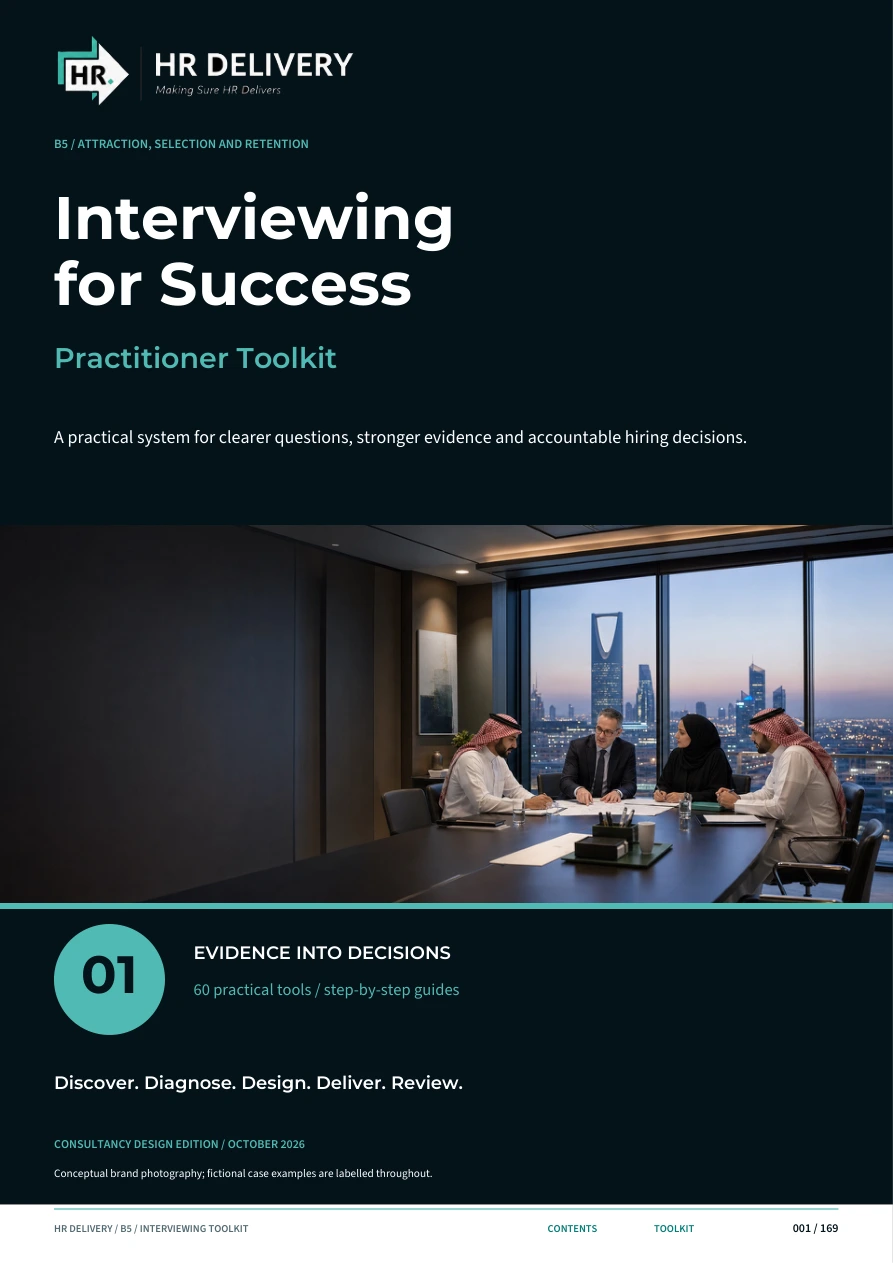
Interviewing for Success Toolkit

Explore the complete toolkit, then use the supporting document alongside the guides and examples.

Complete practitioner toolkit

169pages
60practical tools

Sixty practical tools follow the full assignment: clarify the brief, diagnose current practice, design the interview, support delivery and review results. Each tool brings together a decision, owner, inputs, six working steps, cautions, facilitator wording and a fictional application. Use the matching records in the templates volume to put the guidance into practice.

Open the complete toolkit

160 pages / PDF

Templates, examples & recruitment resources

Sixty working templates are supported by a complete six-question interview, 24 further question cards, a bounded work sample, scoring and communication examples, and three fictional client-report packs. Use the recruitment resources to connect interview design with the wider appointment process.

View supporting document

114 pages / PDF

Diagnostic & Activities Manual

Examine the interview system with a six-domain organisational audit, a 48-item survey in structured and fixed-randomised forms, diagnostic interviews, a focus-group process and an observation checklist. Eighteen facilitated activities support practice, calibration and improvement.

View PDF

PDF resources are in English. Read on screen: Actual view on desktop and full width on mobile.

The thinking behind the tools

Five stages. Six controls.

The B5 application model combines a five-stage journey with six controls for dependable interviewing. The stages organise the assignment; the controls help you examine the quality of the interview system throughout it. The model applies the wider Talent Attraction, Capability Assessment and Competency and Capabilities frameworks to interviewing.

  1. 01

    Discover

    Agree the mandate, analyse the work and establish role requirements, candidate access, data permissions and decision responsibilities.

    12 tools · D01–D12
  2. 02

    Diagnose

    Examine current interviews, records and experience. Identify the causes of inconsistent practice before selecting a solution.

    12 tools · N01–N12
  3. 03

    Design

    Design questions, probes, assessment methods, rating anchors and decision rules. Pilot the complete approach before launch.

    16 tools · S01–S16
  4. 04

    Deliver

    Prepare the panel and candidates, gather evidence consistently, moderate judgements and communicate decisions respectfully.

    12 tools · L01–L12
  5. 05

    Review

    Review process quality, candidate experience and later work outcomes. Agree improvements, ownership and the next controlled version.

    8 tools · R01–R08

Progress when the evidence supports the decision.

Each stage ends with an accountable decision. Missing role criteria, essential access arrangements or data permissions can stop progression. New evidence may send the work back to an earlier stage.

Six controls for examining the interview system. The equal segments are an organising lens, not candidate scores or a validated psychometric model.
  1. 01

    Role clarity

    Define the work, the expected outcomes and the requirements that genuinely matter for appointment.

  2. 02

    Evidence design

    Choose questions, probes and methods that give candidates a fair opportunity to demonstrate relevant capability.

  3. 03

    Candidate access and care

    Plan clear information, appropriate adjustments, language arrangements and respectful treatment.

  4. 04

    Delivery and evidence capture

    Use the agreed process and retain useful observations without replacing evidence with impressions.

  5. 05

    Judgement and decisions

    Apply rating anchors, discuss differences and record the reasoning behind the appointment decision.

  6. 06

    Governance and learning

    Control versions, privacy, accountability and review so the interview system can improve over time.

The B5 organisational audit and 48-item survey examine the interview system. They do not rank candidates or certify interviewer competence. Use role-relevant candidate assessments separately, with appropriate evidence of suitability, trained interpretation and local safeguards. Worked cases and results in the publications are fictional teaching examples.

Explore the model in the toolkit

A connected framework

Talent Attraction Framework

Place interviewing within the candidate journey and connect assessment to genuine need, credible promises and joining.

Explore the interactive framework

A connected framework

Capability Assessment Framework

Connect purpose and role expectations to an evidence plan, calibrated judgement and development.

Explore the interactive framework

A connected framework

Competency and Capabilities Framework

Separate role outcomes, observable behaviours, technical practice and responsibility before drafting interview questions.

Explore the interactive framework

Read & diagnose

Build understanding.
Test the evidence.

Use the ebook to deepen your interviewing practice, the diagnostic and activities manual to examine and develop the system, and the long read to challenge assumptions about what an interview can tell you.

Ebook

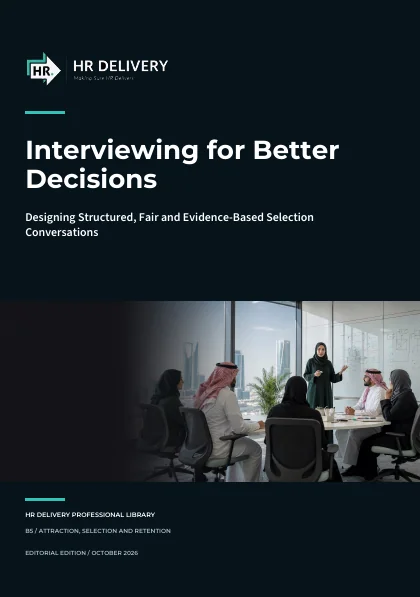
Interviewing for Better Decisions

A 176-page guide to structured questions, behavioural anchors, panel calibration and evidence-led decisions. Includes a six-question practice interview and reusable records.

View PDF

Diagnostic manual

Interviewing for Success: Diagnostic and Activities Manual

The B5 interview-system review: a 24-criterion audit, a separate 48-item survey and 18 facilitated activities. These practitioner tools are not validated candidate tests.

View PDF

Diagnostic manual

Talent Attraction Diagnostic Manual

Review the wider recruitment journey: Need, Promise, Reach, Assess and Commit. Retained DIR-2.0 instrument: 5 dimensions and 20 survey items; do not combine it with the B5 survey.

View PDF

Diagnostic manual

Capability Assessment Diagnostic Manual

Examine the quality of assessment purpose, criteria, evidence, calibration and review. Six dimensions and 24 retained DIR-2.0 survey items diagnose the process, not a candidate’s competence.

View PDF

Diagnostic manual

Competency and Capabilities Diagnostic Manual

Test whether role expectations describe outcomes, behaviours, technical practice and responsibility clearly. Four dimensions and 16 retained DIR-2.0 survey items assess profile quality, not individual ability.

View PDF

Long-read article

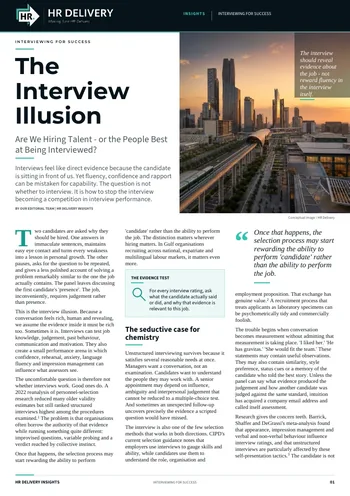
The Interview Illusion

Why confidence, rapport and polished answers can be mistaken for job capability—and how structured evidence changes the conversation.

View PDF

Related assessments

Support development.
Keep the evidence in context.

An interview can be one source of evidence alongside a suitable work sample or assessment. Select methods against the role and their intended use. The links below help you explore relevant options; scores should inform a considered judgement, with appropriate access arrangements and trained interpretation.

  1. Behavioural Competency Assessment

    Level-matched scenarios can inform role-relevant follow-up questions across nine behavioural competencies. Confirm organisational fit and use alongside observed evidence.

    Browse this assessment group
  2. Technical Competency Assessment

    Career-family and level-specific technical scenarios identify areas to explore through structured probes and work samples; they do not establish every practical skill.

    Browse this assessment group
  3. Numerical and Data Reasoning Assessment

    For roles requiring data interpretation, examine the five-dimension reasoning profile alongside a job-related task and interview. Check accessibility and suitability before use.

    Browse this assessment group

Learn & apply

Put knowledge
to work.

Explore a focused one-day introduction or build wider professional capability through a related development programme.

One-day workshop · In-house

An introduction to interviewing for success

A one-day in-house taster: prepare criteria, draft questions, practise neutral probes, record evidence and compare panel judgements.

01

Related development programme

HR Delivery HRBP – Human Resource Business Partners

Three days developing evidence-led people advice, stakeholder conversations and workforce judgement. Supports the HR adviser’s role around hiring decisions; it is not an interviewer qualification.

Explore the programme
02

Related development programme

Management Development: Productivity, People and Performance

Five days using 3P9C to develop clear expectations, balanced judgement, communication and evidence-based people management. Complements hiring-manager development beyond the interview.

Explore the programme

Recruitment support

  • Recruitment Solutions

    Explore the full recruitment offer, from workforce mobilisation to nationalisation and assessment.

    View PDF
  • Assessment for Recruitment Purposes

    Consider the range of assessment options that can support a role-specific selection process.

    View PDF
  • Executive Search

    Explore senior HR, OD and Change appointments through purposeful search, assessment and a supported transition.

    View PDF

A practical starting point

Choose your next step.

  1. 01

    Clarify the role

    Agree the work outcomes, essential entry requirements and evidence needed for a defensible appointment decision.

  2. 02

    Diagnose the system

    Review interview practice, candidate experience and decision records. Use the organisational diagnostic to identify what needs attention.

  3. 03

    Design and rehearse

    Prepare questions, probes, scoring anchors and candidate information. Rehearse and calibrate the panel before a controlled pilot.

  4. 04

    Decide and learn

    Record evidence and decision reasons, provide appropriate feedback and use later experience to improve the next recruitment cycle.

Need help applying it?

Work with HR Delivery to turn the evidence and tools into a response suited to your organisation.

Discuss your priorities